

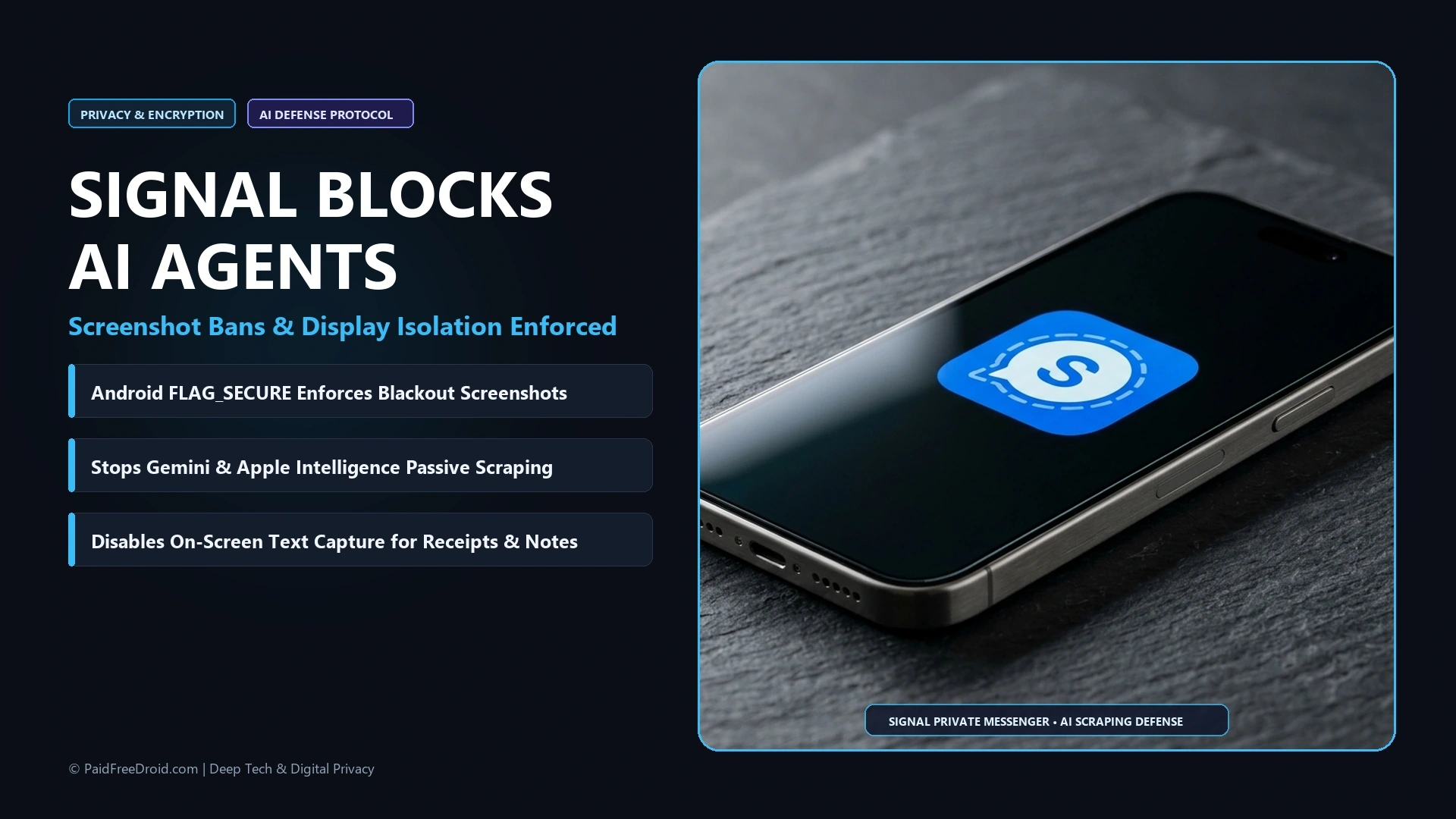
Signal deployed a major security update that blocks system-level screenshots and restricts operating system accessibility scraping across Android and iOS. The move specifically targets the rise of on-device artificial intelligence agents, preventing background engines like Google Gemini on Android, Apple Intelligence on iOS, and Microsoft Copilot from passively reading, indexing, or summarizing private end-to-end encrypted conversations.
Why Everyday Users Are Frustrated by Screen Capture Blocks
While privacy advocates welcome defenses against silent operating system data harvesting, the strict enforcement creates immediate practical friction for regular users. By enforcing Android’s FLAG_SECURE protocol and iOS screen-capture blocking flags, Signal turns entire chat threads black whenever you trigger a hardware screenshot shortcut. Users who routinely capture digital receipts, payment confirmations, travel tickets, or addresses shared by family members can no longer save visual records within the app.
The restriction also disrupts assistive tools. By blocking third-party accessibility APIs from inspecting view hierarchies, Signal shields text from rogue AI screen scrapers, but visually impaired users relying on custom screen readers or automated text-to-speech engines face unexpected navigation barriers.
Defending Private Conversations Against OS-Level AI Agents
Signal’s engineering team argues that end-to-end encryption alone is no longer enough to guarantee privacy in 2026. While encryption scrambles messages across carrier cellular networks and cloud servers, modern mobile operating systems increasingly use background neural models to capture pixel buffers and parse on-screen content directly from local display memory.
Without hardware display flags, features like Pixel Screenshots, Galaxy AI on-screen translators, and Apple Intelligence contextual summaries could easily build searchable semantic indexes of intimate chats. Signal’s updated client treats the host operating system itself as an untrusted environment, cutting off display buffer access before system AI agents can ingest the raw plaintext.
AI Privacy Guardrails: How Signal, WhatsApp, and Telegram Compare
| Privacy Guardrail | Signal | Telegram | |
|---|---|---|---|
| OS Screen Scraping Defense | Enforced by default; blocks screenshots | Optional; enabled only for view-once media | Optional secret chats only; regular chats open |
| System AI Ingestion Blocking | Blocks accessibility buffer scraping | Open display buffer; vulnerable to OS AI | Open display buffer; vulnerable to OS AI |
| End-to-End Encryption | Default across all 1-on-1 and group chats | Default across all personal messaging | Disabled by default; secret chats opt-in |
| Cloud Backup Encryption | No cloud storage; encrypted local transfer | Optional passkey encryption on iCloud/Drive | Server-stored cloud chats unencrypted by default |
| Metadata Telemetry Logging | Zero IP, contact, or timestamp retention | Extensive device, IP, and contact telemetry | Extensive account and connection logs |
Indian Privacy Landscape: Contrast with Meta AI in WhatsApp
For Indian consumers navigating compliance under the Digital Personal Data Protection Act, Signal’s uncompromising stance exposes a massive philosophical split with WhatsApp. With over 500 million active users in India, WhatsApp remains the country’s primary communication channel. Rather than blocking AI ingestion, Meta is actively doing the exact opposite by embedding Meta AI directly into WhatsApp search bars and group chats.
While Meta recently introduced stronger security controls, such as first-party cloud backups with mandatory passkeys on iOS, WhatsApp leaves Android screen capture wide open for convenience. Indian privacy conscious users must weigh this trade-off: convenient receipts and banking confirmations in WhatsApp, or absolute display isolation in Signal that locks out both third-party snoops and your own screenshot button.
Stay Ahead in the Tech World
Join our community for breaking news, exclusive gadgets coverage & direct admin support.


