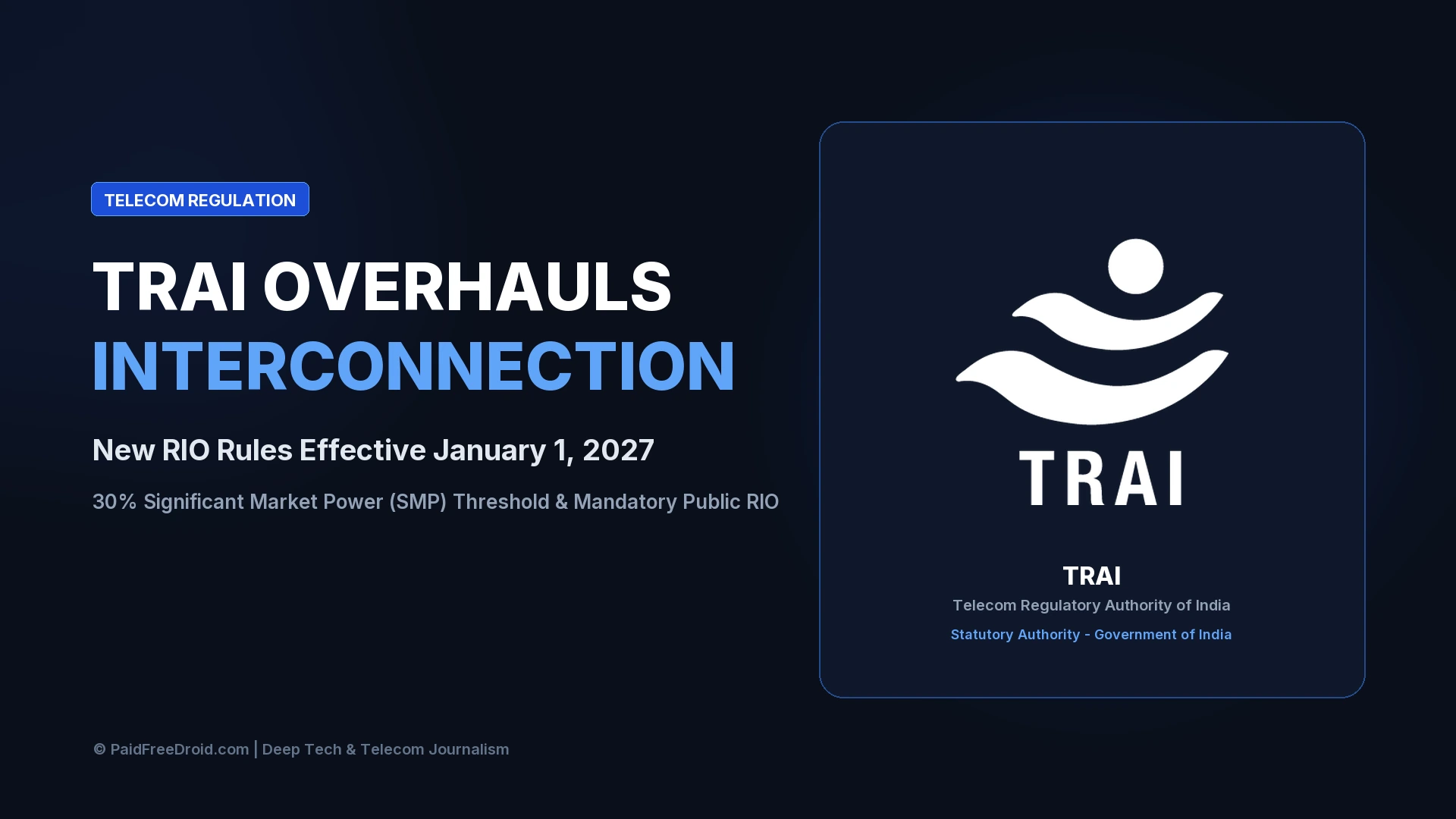
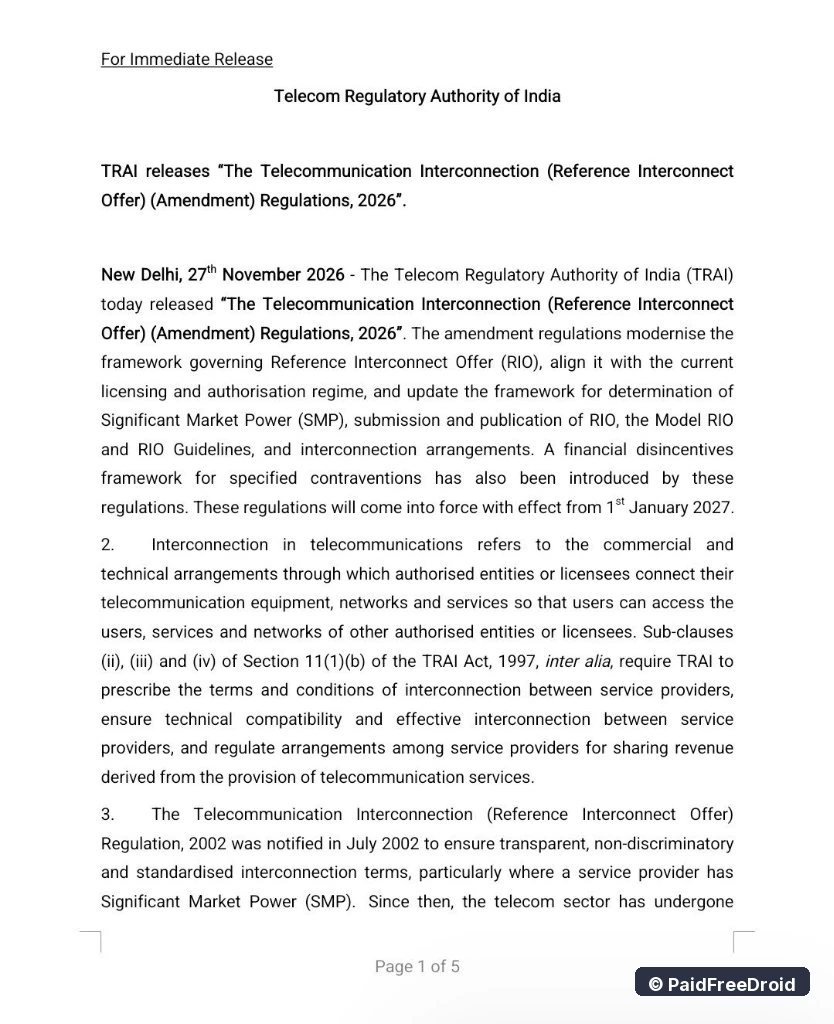
The Telecom Regulatory Authority of India (TRAI) has notified the Telecommunication Interconnection (Reference Interconnect Offer) (Amendment) Regulations, 2026, modernizing India’s carrier interconnection architecture. Taking effect January 1, 2027, the new regulations establish a clear 30% market share threshold for Significant Market Power (SMP), mandate public Reference Interconnect Offer (RIO) filings, replace legacy circuit routing with circle-level IP networks, and introduce graded financial penalties for non-compliance.
Key Highlights of New Interconnection Rules
- Four SMP Criteria: Telcos are designated as having Significant Market Power if they command 30% or more market share in Adjusted Gross Revenue (AGR), Subscriber Base, Voice Call Handling Capacity, or Traffic Volume.
- Service Coverage: Evaluated annually across Wireline Access, Wireless Access, National Long Distance (NLD), and International Long Distance (ILD) services per licensed service area (LSA).
- Mandatory RIO Timelines: SMP telcos must submit their draft RIO to TRAI within 30 days and publish approved terms on their website within 15 days, maintaining parity with the transparency in the BSNL TRAI-mandated voice and SMS prepaid tariff portfolio.
- Circle-Level IP Routing: Replaces obsolete 2002 SDCA/LDCA circuit routing with modern packet-switched IP interconnection across telecom circles.
- Financial Disincentives: Prescribes graded penalties per service area for filing delays, with formal opportunities for telcos to represent their case before fines are levied.
TRAI Interconnection Regulations 2026: Framework & Compliance Timelines
| Regulatory Parameter | Provisions & Thresholds | Compliance Timeline |
|---|---|---|
| Significant Market Power | 30% or more share in AGR, Subscribers, Capacity, or Traffic | Evaluated annually after Q1; valid until modified |
| RIO Submission | Submit draft Reference Interconnect Offer to TRAI | Within 30 days of SMP determination |
| Public Disclosure | Publish approved RIO on official telco website | Within 15 days of TRAI approval |
| Directed Revisions | File TRAI-ordered revisions; publish approved changes | Submit in 15 days; publish in 15 days |
| Routing Architecture | Packet-switched IP routing across circles (PSTN, PLMN, NLD) | Mandatory from January 1, 2027 |
| Non-Compliance Fines | Graded financial penalties per circle with right to representation | Applicable upon deadline breach |
Significant Market Power Threshold & Operator Impact
By establishing an objective 30% metric across revenue, customer base, call capacity, and traffic, the new regulations directly impact Reliance Jio and Bharti Airtel, both of which command dominant market shares across India. Rather than negotiating bilateral pacts behind closed doors, SMP telcos must publish non-discriminatory interconnection baselines. This addresses long-standing regulatory disputes examined in our Reliance Jio incoming call suspension and regulatory compliance report.
PFD Context
India’s telecom landscape previously suffered severe point-of-interconnect bottlenecks, notably during 2016 when incumbents restricted trunk port capacity for new entrants. By replacing outdated circuit switching with circle-level IP packet delivery and enforcing transparent 30% SMP obligations, TRAI ensures fair interconnection while consumers evaluate plans in our telecom secondary SIM validity and tariff comparison guide.
Stay Ahead in the Tech World
Join our community for breaking news, exclusive gadgets coverage & direct admin support.