

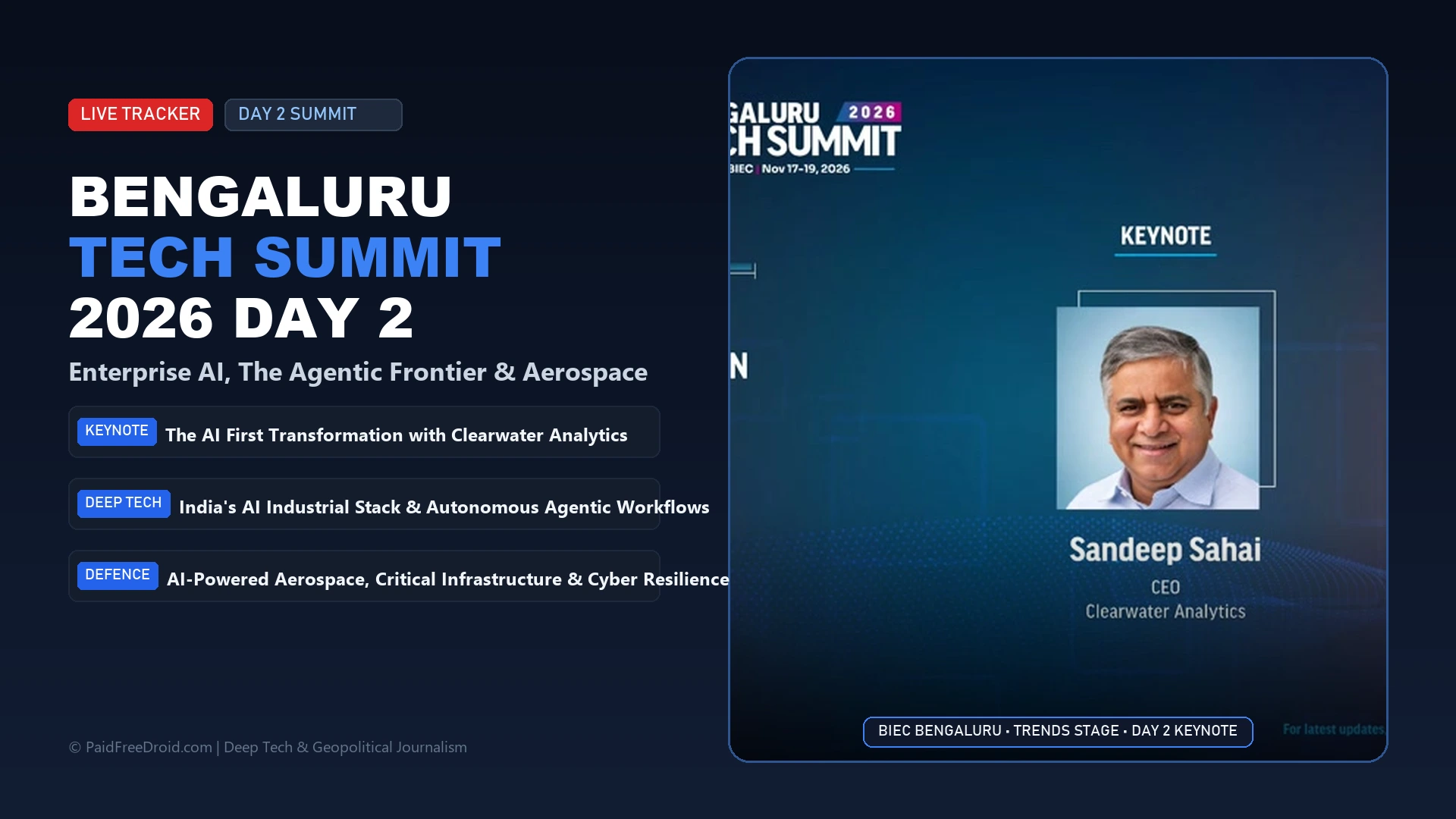
BENGALURU, November 18, 2026 : Day 2 of the 29th Bengaluru Tech Summit (BTS 2026) is officially underway at BIEC Bengaluru under the central theme “Unbound.” Following Day 1’s policy and semiconductor roadmap announcements, Day 2 pivots directly into production deployment across Enterprise AI, autonomous agentic architectures, and sovereign aerospace engineering. With over 50,000 global delegates, cloud architects, and defense strategists convening across the Trends Stage and GIA pavilions, PaidFreeDroid provides live, minute-by-minute editorial coverage, executive speech transcripts, and technical architecture breakdowns directly from the keynote floor.
• Fraunhofer ISST on Industrial AI: Governance, Ownership, and the Math of Federated Training: Taking the Trends Stage during The AI Industrial Stack track at BTS 2026, researchers from Germany's Fraunhofer Institute for Software and Systems Eng.
• The 4% Reality: Trends Stage Panel Exposes Massive Enterprise AI Pilot vs. Payoff Gap: In a reality-check session on the Trends Stage at BIEC, enterprise technology leaders dissected why widespread corporate AI adoption has largely faile.
• "Buying an AI Gym Membership Doesn't Build Muscle": Trends Stage Panel Calls Enterprise AI Budget Magic a Myth: Kicking off the high-stakes panel on Enterprise AI: What Scales, What Pays , speakers took direct aim at the corporate illusion that throwing budget a.
• "Lean Before Agents": The Two Architectural Trails Taking AI from Promise to Production: In an impactful keynote on the Trends Stage at BIEC, speakers laid out the organizational blueprint required to move autonomous software agents from p.
• $120 Billion Cumulative Capital, $130B in Annual Tech Exports: Trends Stage Spotlights Bengaluru Hub Telemetry: Highlighting Bengaluru's commanding position as Asia's deep tech epicenter, the morning plenary revealed the macro financial metrics driving the state.
First Edition AI Aerospace Paper Unveiled: The Defense Autonomy vs. Civil Certification Divide: Presenting the first edition of the landmark state white paper on AI in Aerospace, Defence & Space on the Trends Stage at BTS 2026, industry architects dissected the structural divergence between military combat adoption and civilian flight certification:
"This is the first version of our roadmap examining how AI enters aerospace. On the manufacturing and process engineering side, adoption is moving aggressively. But when it comes to placing AI directly on flight platforms, there is a fundamental split: in defense, operational necessity allows rapid autonomous deployment; on the civil aviation side, safety-critical certification creates severe hurdles. Ultimately, AI adoption in aerospace is a mindset challenge, not a compute limitation."
Key findings detailed from the newly unveiled aerospace paper:
- The Dual-Speed Reality: Factory-floor predictive maintenance, wind-tunnel simulation modeling, and robotic manufacturing are rapidly integrating neural networks. However, onboard fly-by-wire and avionics systems remain bound by deterministic DO-178C software standards that resist probabilistic neural models.
- Military Urgency vs. Civil Caution: While loitering munitions, autonomous swarms, and electronic warfare pods tolerate acceptable algorithmic confidence scores, passenger aviation demands 100% explainable, deterministic failure bounds before autonomous flight controllers can be certified.
- The Mindset Bottleneck: The white paper concludes that India's aerospace ecosystem cannot wait for Western aviation regulators to write AI standards; domestic regulatory authorities (CEMILAC, DGCA) must actively formulate indigenous neural certification frameworks.
Official BTS 2026 Press Conference Commences at BIEC: Government & Industry Convene for Midday Directives: Summit organizers, Karnataka state IT/BT leadership, and global trade delegations have formally taken the dais at the BIEC Media Centre as the official Bengaluru Tech Summit 2026 Press Conference goes live (Stream ID: LUNkzQKYQlI):
- Key Policy Announcements on the Docket: The briefing is expected to announce major bilateral corporate investment MOUs, state incentives for Global Capability Centers (GCCs) expanding into Tier-2 tech clusters, and implementation timelines for the Deep Tech & AI Policy announced on Day 1.
- International Delegations: Envoys from European, Indo-Pacific, and North American tech corridors are participating in the briefing to finalize cross-border research pacts and semiconductor supply chain tie-ups.
- Parallel Track Alert: Concurrently on the Trends Stage, delegates are concluding the AI-Powered Aerospace & Defence plenary while production crews stage microphones for The Agentic Frontier (Stream ID:
fMAwmDzyQlM), focusing on multi-agent software architectures.
"Models Are a Commodity, Process Knowledge Is the Moat": Aerospace Leaders on Defense AI Sovereignty: In a high-impact technical exchange during the AI-Powered Aerospace & Defence plenary on the Trends Stage at BTS 2026, defense engineering strategists cut through the hype surrounding foundation models, pinpointing where sovereign military autonomy actually resides:
"Foundational models are going to become a commodity. General AI compute and model weights will be accessible to everyone across the globe. What is NOT going to be a commodity is your structured knowledge repository and the deep engineering process knowledge you have accumulated over decades. That proprietary telemetry is your true moat, and that is what sovereign defense models must be trained on."
Key strategic pillars established by the aerospace defense panel:
- The Commoditization of General Weights: Defense architects noted that attempting to build generic commercial LLMs wastes military capital. Off-the-shelf algorithmic architectures are ubiquitous; the strategic differentiator is proprietary mission data.
- Decades of Telemetry as Sovereign Assets: India's competitive edge lies in the flight telemetry, radar cross-section libraries, sensor logs, and aerodynamic failure records amassed by national agencies (DRDO, HAL, ISRO, NAL) and domestic aerospace primes over 30+ years.
- Isolated On-Premises Fine-Tuning: Mission-critical defense algorithms for autonomous flight control, target identification, and counter-EW (Electronic Warfare) must be trained entirely on air-gapped infrastructure using structured, sovereign operational repositories.
"From 7 People to Precision Manufacturing": Aerospace Founders on Localizing 40% of Defense Component Stacks: Opening the technical presentations on the Trends Stage during the AI-Powered Aerospace & Defence plenary (Stream ID: LrXJj8SN_QM), indigenous aerospace entrepreneurs detailed the operational scaling curves required to build mission-critical defense hardware:
"We started seven years back with just seven people. Today, we have matured to an operational scale where we execute precision intervention manufacturing. For most of the products we manufacture today, over 40% of the components that enter our systems are sourced directly from domestic suppliers within India, and we are accelerating that ratio further."
Key operational and strategic takeaways from the aerospace presentation:
- Domestic Supply Chain Deepening: Rather than assembling imported knocked-down kits, domestic aerospace startups are establishing localized machining, sensor fabrication, and electronics assembly corridors across Karnataka's aerospace belts.
- Intervention Manufacturing Precision: Building defense-grade hardware requires moving beyond rapid software iteration to zero-tolerance physical machining capable of enduring extreme thermal, vibrational, and electronic warfare stresses.
- The Localization Imperative: Crossing the 40% domestic sourcing threshold marks a critical inflection point for military procurement compliance, sovereign supply chain insulation, and long-term maintenance self-reliance.
"Compress 30 Years of IT into 5 Years of Deep Tech": STPI on Shifting India from Services to Product IP: In a defining plenary session on the Trends Stage at BTS 2026, leadership from the Software Technology Parks of India (STPI) and ecosystem moderators issued a call to compress India's macroeconomic technology timeline:
"Whatever is being projected for India 2047 should happen tomorrow. Whatever has happened over the last three decades in India's IT services industry, the exact same scale and impact must happen over the next five years in the deep tech startup ecosystem. That is what will permanently rewrite India's economic trajectory from a global services hub into a sovereign product powerhouse."
Addressing STPI's operational transformation, leadership detailed key programmatic shifts:
- Beyond Real Estate & Park Management: STPI is formally shedding its legacy identity as a provider of physical office space and basic connectivity. Instead, it is repositioning as a national deep-tech funnel, connecting university labs with enterprise sandboxes and capital allocators.
- Industry-Led Domain Innovation Across Karnataka: Under newly launched STPI initiatives, domain-specific AI testing clusters are being distributed beyond Bengaluru into Tier-2 and Tier-3 hubs across Karnataka, pairing local university researchers with established manufacturing and healthcare primes.
- Compressing the IP Lifecycle: To replicate India's $130B software export velocity in the product domain, state and central authorities are synchronizing regulatory approvals, grant disbursements, and sovereign compute access into rapid 6-to-12-month commercialization cycles.
Official Report Release: Karnataka to Unveil Landmark Study on AI in Aerospace, Defence & Space: The 2:30 PM strategic track on the Trends Stage opens with a marquee institutional milestone: the formal launch of the state's authoritative Report on AI in Aerospace, Defence & Space, establishing India's roadmap for military and orbital autonomy:
- The Landmark Study: Compiled by defense strategists, aerospace primes, and space-tech founders, the report maps the sovereign integration of computer vision, autonomous guidance algorithms, and low-SWaP edge computing across civilian aviation, defense combat platforms, and satellite constellations.
- Strategic Panel Focus: Following the document unveiling, aerospace commanders and deep tech founders take the stage for the plenary panel: Aerospace & Defence: The AI Advantage. Key focus areas include:
- Accelerating indigenous testing pipelines for mission-critical neural flight control software.
- Dual-use technology export regimes and intellectual property protection for domestic drone makers.
- Bridging defense procurement cycles with venture-backed military AI spinouts.
- Live Stage Telemetry: Production feeds confirm the morning block has ended and the Aerospace & Defence live broadcast (Stream ID:
LrXJj8SN_QM) is commencing on stage.
Stage Switch to AI Aerospace & Defence: Bengaluru Hub Prepares to Tackle Autonomous Combat & Edge Avionics: Following the conclusion of the foundational AI stack plenary, the Trends Stage is transitioning directly into one of BTS 2026's marquee strategic tracks: AI-Powered Aerospace & Defence (starting at 2:30 PM IST):
- Bengaluru's Aerospace Hegemony: Hosting over 65% of India's aerospace manufacturing and research ecosystem (anchored by DRDO, HAL, ISRO, and NAL), Bengaluru has emerged as the testbed for indigenous defense autonomy. The incoming track addresses how military planners and deep-tech founders are accelerating hardware-software convergence.
- Core Discussion Pillars:
- GPS-Denied Navigation & Edge Compute: Deploying computer vision and neural navigation stacks on low-SWaP (Size, Weight, and Power) silicon capable of operating in heavily contested electronic warfare environments without satellite connectivity.
- Autonomous Swarm Intelligence: Coordinated drone swarm behaviors, collaborative sensor fusion, and distributed target acquisition for loitering munitions.
- Sovereign Avionics Stacks: Replacing foreign flight control and radar processing algorithms with indigenously audited, mission-critical neural architectures.
- Live Stream Transition: The embedded player above is transitioning to track the dedicated live feed for the Aerospace & Defence plenary (Stream ID:
LrXJj8SN_QM).
"India Must Build $100B Market Cap AI Giants": Trends Stage Panel Lays Out 5-Year Tripartite Roadmap: Resuming live discussions on the Trends Stage at BTS 2026, technology leaders and venture strategists issued a direct benchmark for India's software ecosystem: shifting from modest venture exits to producing world-dominant, $100-billion deep-tech platforms:
"AI is fundamentally leveling the global playing field in product development. Today, an Indian engineering team can legitimately aspire to build a globally competitive product in a single generation because development methodologies are being completely rewritten. But our benchmark cannot just be domestic scale: we should aspire to produce at least a couple of startups that command $100 billion in market cap. For that to happen, it cannot just be an India product; it must be a global product."
To realize this five-year milestone, the panel outlined explicit responsibilities across the technology ecosystem:
- Startups (Global Product DNA): Indian founders must avoid confining their vision to localized domestic service wrappers. They must build export-grade AI products with global developer workflows from Day 1, leveraging domestic volume in sectors like healthcare and fintech as a high-density training ground.
- Academia (Commercial Spinouts Over Citations): Research universities (IISc, IITs) must measure academic success not merely by paper citations, but by translational spinouts and retained patent equity.
- Government (Anchor Procurement & Compute): State and federal authorities must serve as sovereign anchor buyers for domestic AI products and continue expanding GPU compute access under national mission frameworks.
Karnataka's $130B IT Export Milestone & STPI Deep Tech Honors: Exhibition Floor Telemetry: While the Trends Stage completes final audio checks and podium staging for the afternoon's Research to Reality and AI Aerospace sessions, Day 2 has registered major industrial telemetry across the BIEC exhibition grounds:
- The $130 Billion Export Vanguard: The Software Technology Parks of India (STPI) IT Export Awards highlighted the enterprise scale anchoring Karnataka's global footprint. Bengaluru-based software engineering hubs, Global Capability Centers (GCCs), and enterprise SaaS firms now generate over 38% of India's total software exports, outperforming national growth averages.
- Bioinformatics & Deep Tech Synthesis: Parallel honors at the Smart Bio Awards recognized indigenous breakthroughs in genomic data modeling, automated clinical trials, and computational drug discovery. The state's biotechnology policy is committing specialized computational infrastructure to support over 100 translational bio-AI ventures over the next 24 months.
- Stage Telemetry: Production crews on the Trends Stage are finalizing microphone levels and slide decks as delegates fill the auditorium for From Research to Reality, directly preceding the high-profile 2:30 PM Aerospace & Defence track.
The Academic-to-Commercial Chasm: Why India's Sovereign AI Ambition Hinges on Lab Spinouts: As the Trends Stage commences its afternoon track on From Research to Reality: Powering India's AI Innovation Economy, institutional leaders are confronting the structural gap between pure academic patent filings and scalable commercial enterprise software:
- The 3% Commercialization Bottleneck: Historically, less than 3% of foundational deep-tech patents originating from premier Indian research hubs (IISc, IITs, C-DAC) successfully translate into venture-backed production software. The afternoon plenary takes direct aim at the missing translational foundry layer.
- IndiaAI Compute Subsidies: Government representatives and university directors are spotlighting the role of state-subsidized compute infrastructure under the national IndiaAI Mission. By offering sovereign GPU clusters to university spinouts, researchers no longer face prohibitive multi-million-dollar training bills on foreign hyperscaler clouds.
- Sovereign IP Retention: Key speakers emphasize that without aggressive domestic venture capital willing to underwrite multi-year deep tech gestation cycles, India risks training the world's top algorithmic talent only to have the resulting intellectual property acquired and commercialized abroad.
Stay Ahead in the Tech World
Join our community for breaking news, exclusive gadgets coverage & direct admin support.

