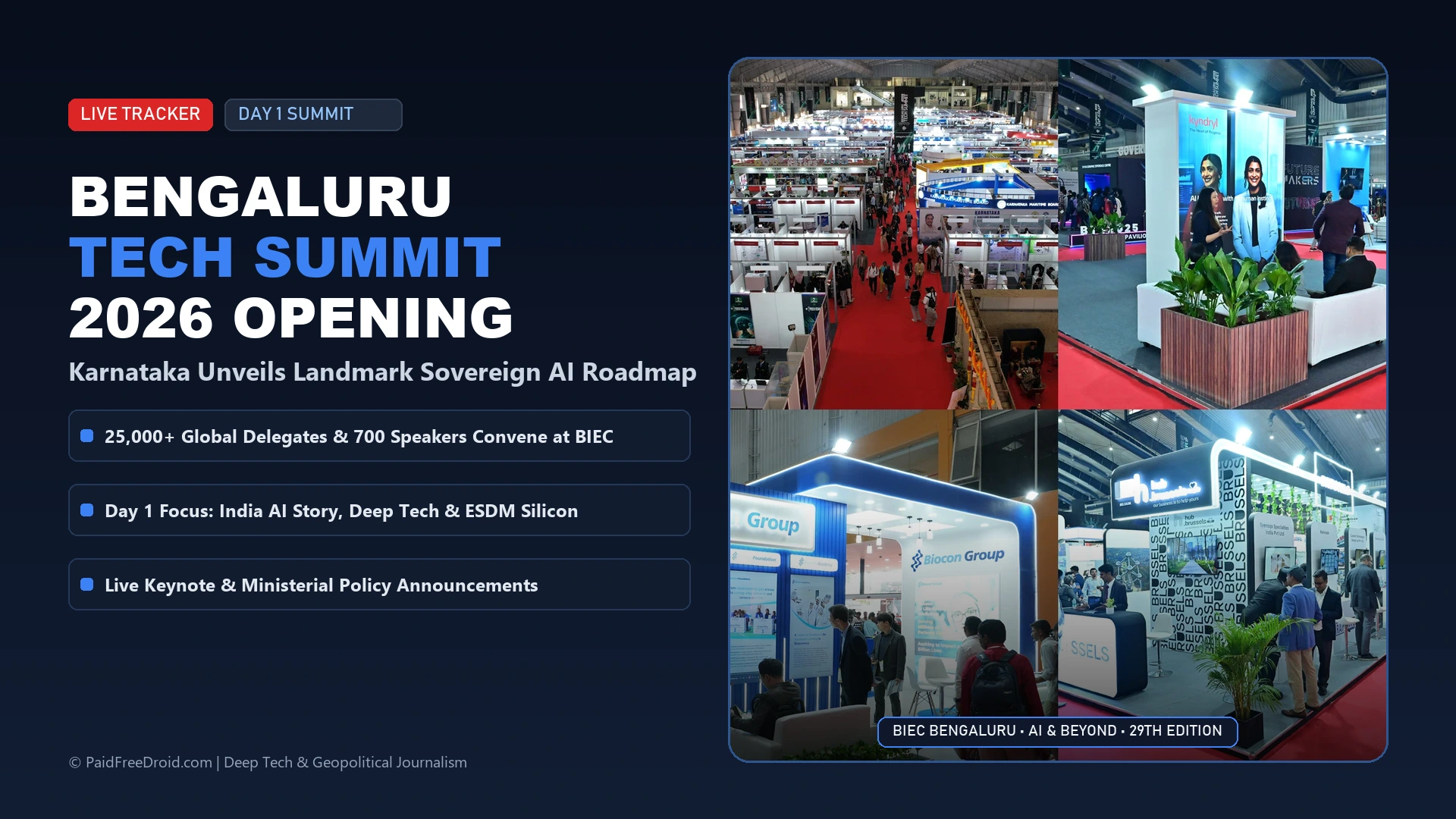
BENGALURU, November 17, 2026 : Karnataka has officially kicked off the 29th edition of the Bengaluru Tech Summit (BTS 2026) at Bangalore Palace today under the central theme “Unbound.” Attracting over 50,000 global delegates, technology executives, researchers, and venture investors across 45 participating nations, Day 1 sets the policy and architectural tone with major roadmaps spanning sovereign compute, state-backed deep tech funds, and ESDM semiconductor incentives. As global tech leaders convene for high-stakes afternoon tracks focusing on the India AI Story, defense microelectronics, and fabless chip design, PaidFreeDroid provides comprehensive, minute-by-minute real-time coverage from the keynote floor.
• BTS 2026 opens at Bangalore Palace with 50,000+ delegates and 45 nations
• Karnataka government outlines sovereign AI roadmap and ₹2,500 Cr deep tech corpus
• Afternoon tracks open at 2:00 PM IST: India AI Story, ESDM Semiconductors, and Defense AI
Day 1 Evening Recap & Day 2 Preview: Day 1 of Bengaluru Tech Summit 2026 has concluded at Bangalore Palace. Today established landmark foundations for Karnataka's ₹2,500 Crore deep tech corpus, sovereign compute sandboxes, and semiconductor ATMP package incentives. Live coverage resumes tomorrow morning at 9:30 AM IST for Day 2, focusing on Startup Pitch Battles, Biotech Computing, and Global Innovation Alliance agreements.
Trends Stage Session 5 - Human-Centric AI: The final breakout on the Trends Stage today convenes industry ethicists and deep tech architects for 'Human-centric AI: Directions for Future' (streaming via official session feed). Key takeaways focus on explainable AI models, algorithmic bias mitigation in public sector deployments, and synthetic data provenance frameworks.
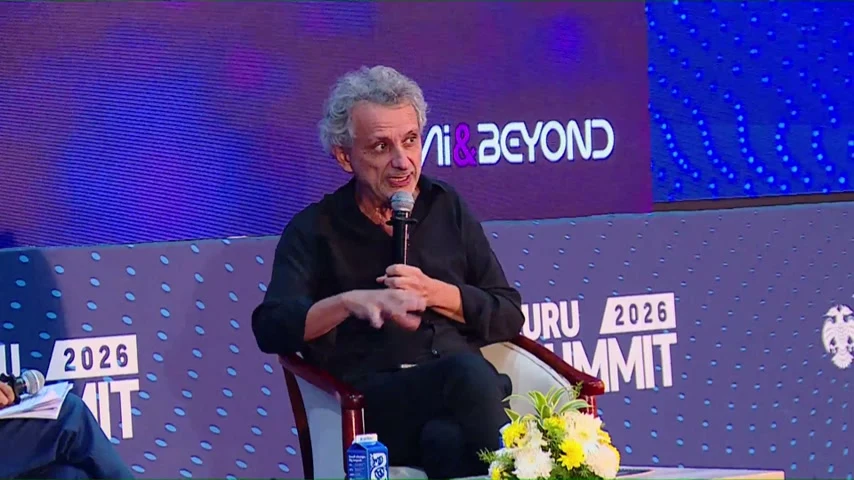
🔴 Live from Trends Stage: "You Cannot Fix Everything with a Patch on Top"
Following the conclusion of Session 4 on workplace automation and cognitive labor reallocation, Trends Stage Session 5 is now broadcasting live from Bangalore Palace, tackling foundational AI alignment and human-centric systems.
Listening live to the stage audio, speakers warned against relying on post-hoc safety guardrails rather than addressing architecture design from the ground up:
"These are general models. They are able to do anything, so you cannot fix everything with a patch on top saying 'Oh, we fixed it.' That does not make sense. You have to think about it when you are building the model, not after."
The panel emphasized that enterprise governance must mandate architectural transparency and synthetic data provenance during pre-training, rather than attempting to enforce behavioral constraints solely via post-training reinforcement loops.
Trends Stage Session 4 Preview: Following the conclusion of Session 3, the Trends Stage at Bangalore Palace is prepping for Session 4: 'AI & Beyond: Gen Z, Gen Alpha and the Future of Work' (streaming via official session feed). The keynote session will evaluate enterprise automation, cognitive labor reallocation, and cross-generational workplace AI tooling across India's IT corridors.
Trends Stage Session 4 Preview: Following the conclusion of Session 3, the Trends Stage at Bangalore Palace is prepping for Session 4: 'AI & Beyond: Gen Z, Gen Alpha and the Future of Work' (streaming via official session feed). The keynote session will evaluate enterprise automation, cognitive labor reallocation, and cross-generational workplace AI tooling across India's IT corridors.
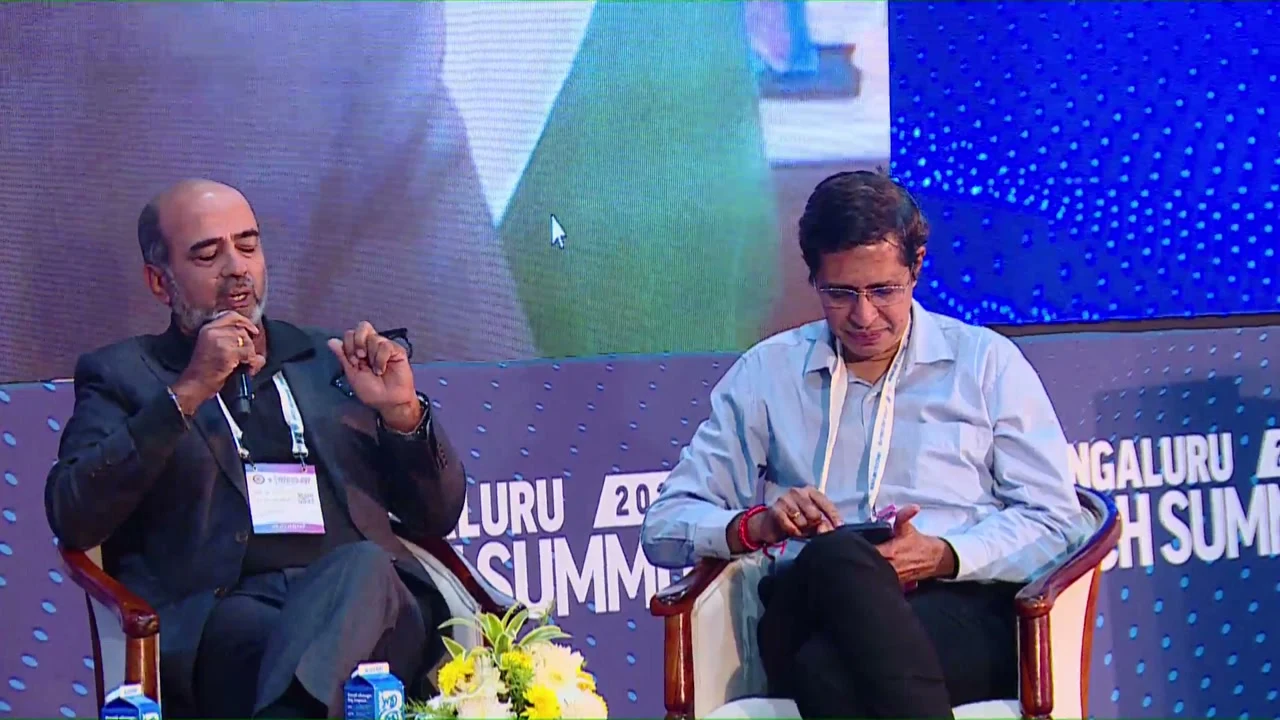
Direct from the Live Stream: "Do You Have the Ability to Question an Answer Given by AI?"
Listening live to the ongoing Session 3 panel at Bangalore Palace, speakers tackled the core dilemma facing modern engineering education: shifting students from passive consumers of generative models to adversarial interrogators of machine intelligence.
"Fundamental skills are changing," a panelist emphasized passionately from the stage. "Do you have the ability to question an answer that is given by AI? Or if I give you an AI-driven answer, do you have the foundational knowledge to comment on it and find its flaws? That is the real test of engineering capability in this era."
The panel underscored that rote testing is obsolete when foundation models can pass standard examinations, emphasizing that university assessment rubrics must evaluate critical verification and multi-step reasoning.
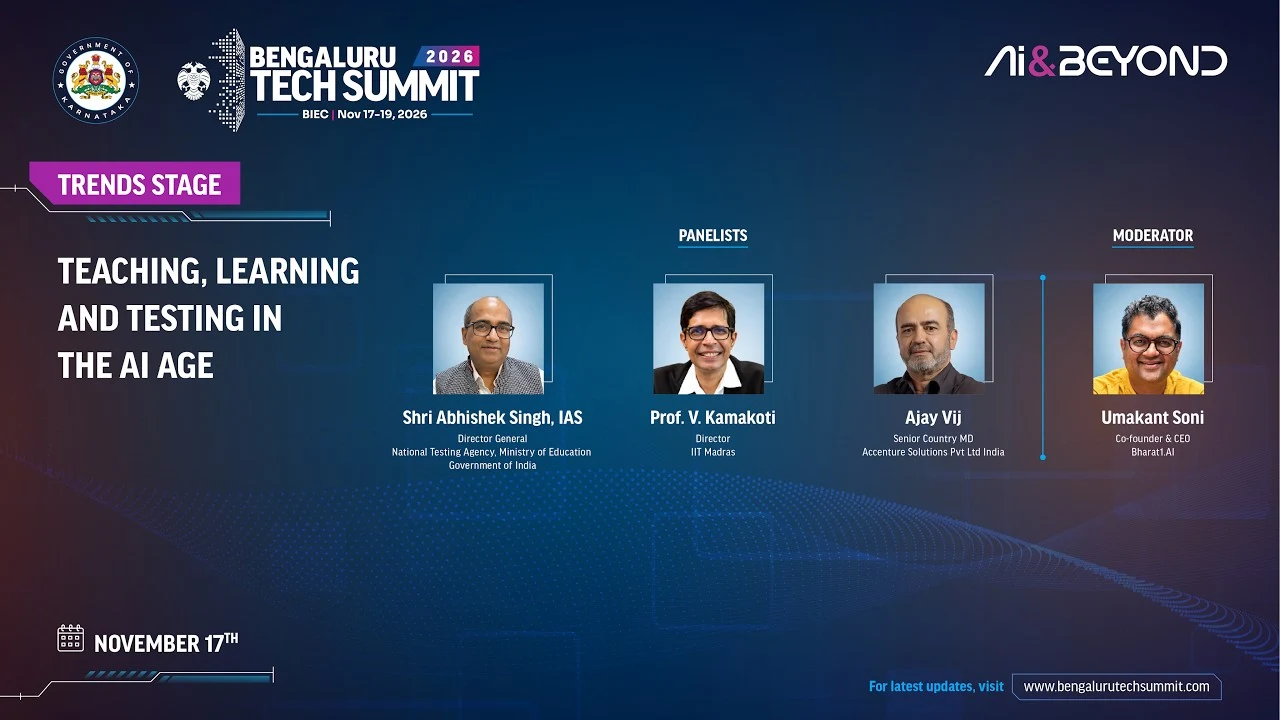
🔴 Live from Trends Stage - Session 3 Now Streaming: Broadcast feeds from Bangalore Palace confirm that Trends Stage Session 3 is actively live streaming, featuring leading academic researchers, EdTech innovators, and policy strategists discussing 'Teaching, Learning, and Testing in the AI Age.'
Key live themes being debated on stage include:
- Foundational AI Literacy: Restructuring undergraduate computer science and electronics curricula to mandate prompt engineering, machine learning pipelines, and model evaluation protocols.
- Sovereign EdTech Sandboxes: Integrating state-subsidized compute infrastructure into engineering institutions across Karnataka to enable hands-on AI prototyping.
- Evaluation in the Generative Era: Shifting assessment paradigms away from rote memorization toward problem synthesis, automated code review, and ethical AI auditing.
Sessions 4 and 5 ('Future of Work' and 'Human-Centric AI') are scheduled to follow immediately on the Trends Stage upon conclusion of the current panel.
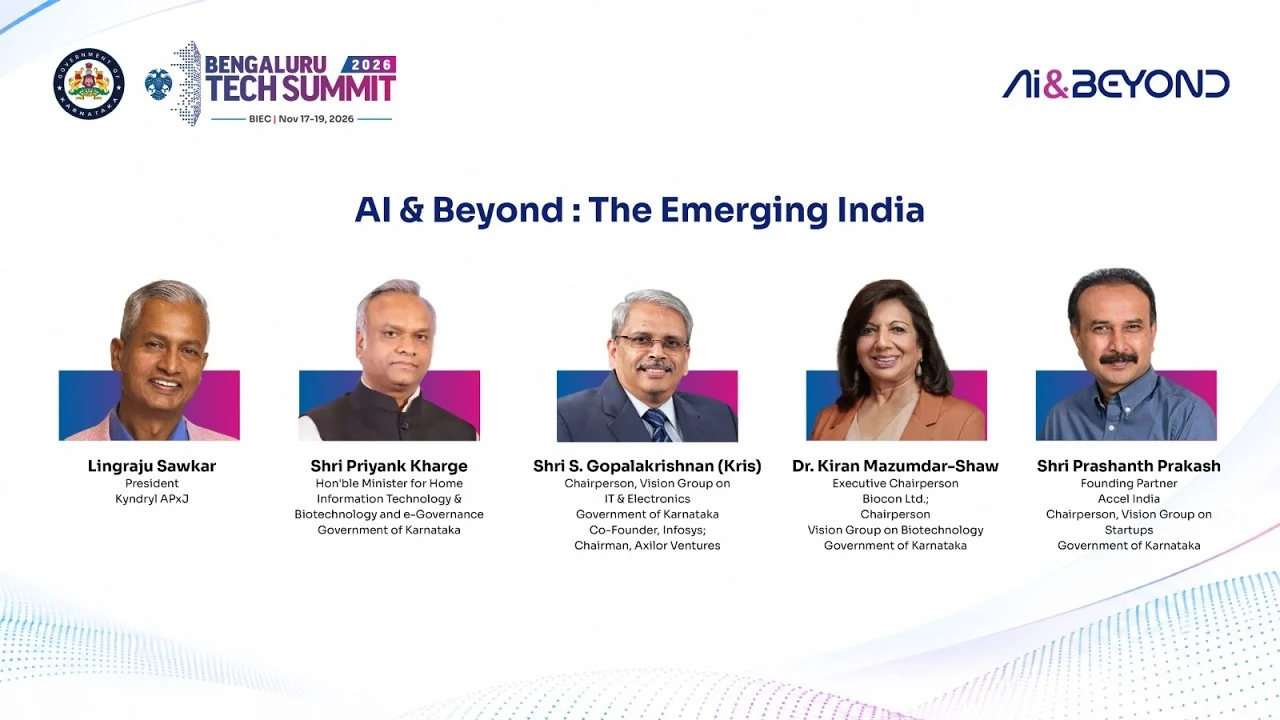
Stage Broadcast Capture: Official stage video from Bangalore Palace captured the panel discussing domestic compute infrastructure. Minister Priyank Kharge reiterated Karnataka's commitment to subsidize compute access for early-stage AI research labs, preventing foreign architecture lock-in and accelerating indigenous Indic language AI deployment.
Silicon & Hardware Ecosystem: During the inaugural plenary, Micron India Managing Director Anand Ramamoorthy and NXP Semiconductors Senior VP Maulin Patel detailed the rapid expansion of India's semiconductor manufacturing and packaging footprint. Highlighting advancements in memory packaging, automotive microcontrollers, and secure edge processors, the executives emphasized that Bengaluru's fabless design cluster must integrate closely with upcoming domestic ATMP/OSAT facilities. KEONICS Chairman Sharath Bache Gowda confirmed expanding infrastructure across state electronics parks to support specialized cleanrooms and test centers.
Main Stage Spotlight: A landmark panel on 'AI & Beyond: The Emerging India' brought together Karnataka IT & BT Minister Priyank Kharge, Biocon Executive Chairperson Dr. Kiran Mazumdar-Shaw, Infosys Co-founder Kris Gopalakrishnan, and Accel India Founding Partner Prashanth Prakash, moderated by Kyndryl APxJ President Lingraju Sawkar. Discussions centered on establishing India's sovereign AI infrastructure to prevent architectural dependency on foreign foundation models, integrating generative AI into biotechnology drug discovery pipelines, and channeling venture capital into deep tech silicon startups rather than purely consumer software. Minister Kharge reiterated that Karnataka will provide subsidized compute access and regulatory sandboxes to accelerate indigenous IP development.
Stay Ahead in the Tech World
Join our community for breaking news, exclusive gadgets coverage & direct admin support.