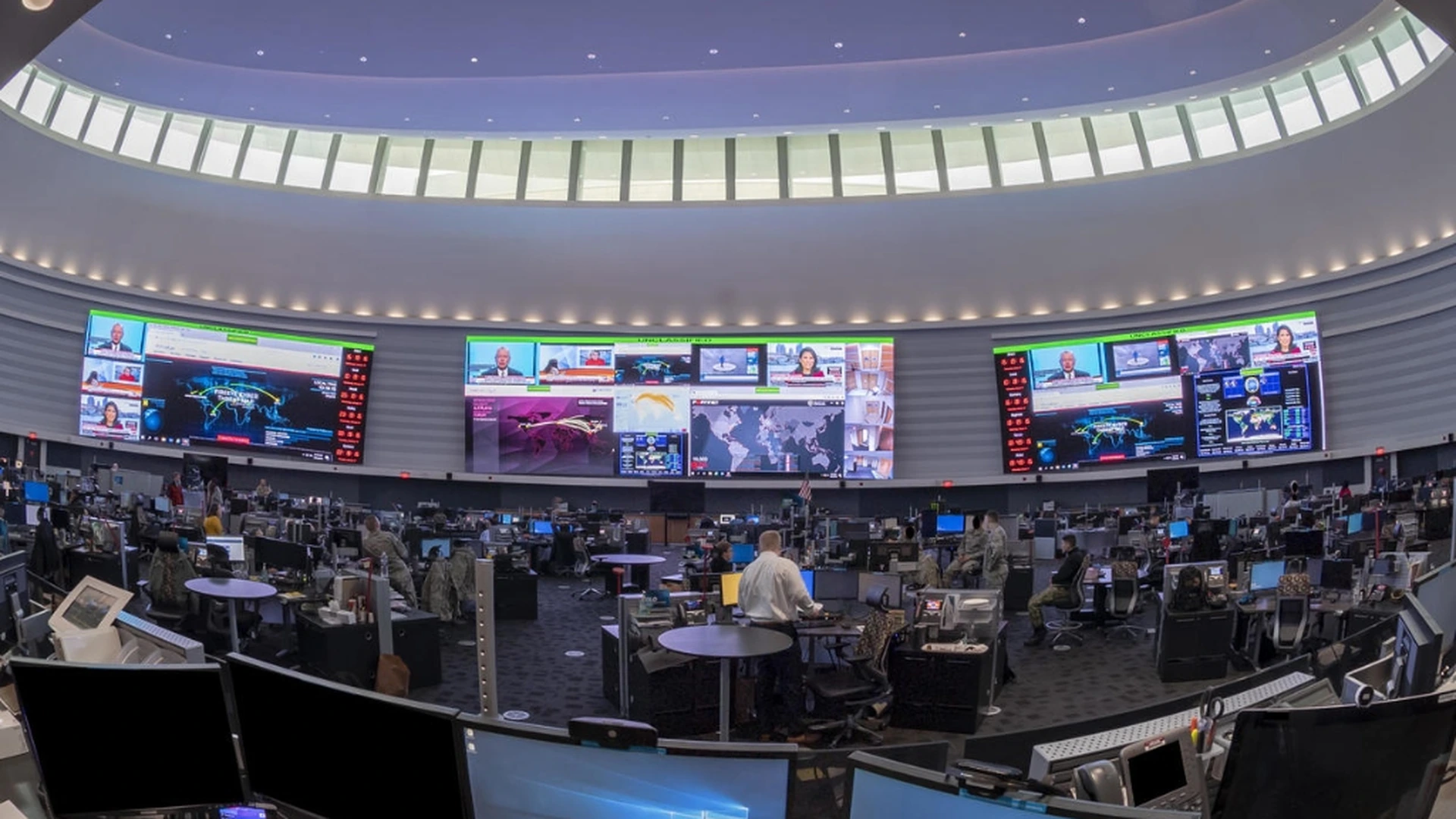
In a major national security cyber incident driving over 100,000 emergency search queries nationwide, hackers have breached Cloud One, the United States Air Force’s flagship multi-cloud computing enterprise. The sophisticated intrusion compromised administrative control planes governing the Theater Integrated Combat Munitions System (TICMS)-which audits live bomb and missile inventories across 200 operational air installations worldwide-and the Cloud-Based Command and Control (CBC2) air-defense radar network. Uncovered during a scheduled infrastructure upgrade cycle, the breach triggered emergency containment protocols led by U.S. Cyber Command (CYBERCOM), including frozen software migrations and the immediate revocation of enterprise administrative credentials.
Air Force Hacked: Confirmed Breach Details and Immediate Impact
Cloud One serves as the centralized computing backbone for the Department of the Air Force, consolidating enterprise workloads from both the U.S. Air Force and the U.S. Space Force across commercial cloud hyperscalers. While Pentagon officials have declined to identify the specific advanced persistent threat (APT) actor responsible, federal disclosures confirm that the intrusion caused widespread operational disruption across Air Force IT services:
- Control-Plane Exploitation: Threat actors leveraged an unpatched software vulnerability inside the platform management layer during an active maintenance window, gaining unauthorized access to privileged orchestration backbones.
- Strategic Defense Assets Exposed: Impacted systems include TICMS (global munitions inventory auditing across 200+ global air bases) and CBC2 (homeland air-defense radar feeds used by NORAD to track aerospace movements).
- Platform-Wide Emergency Freeze: Air Force cybersecurity teams halted all active software migrations, blocked scheduled operating system updates, and revoked administrator credentials to prevent lateral movement between unclassified and classified enclaves.
- Active CYBERCOM Incident Response: Forensic specialists from U.S. Cyber Command and 16th Air Force (Air Forces Cyber) deployed to determine whether munitions telemetry, aircraft readiness metrics, or maintenance logs were actively exfiltrated.
Multi-Cloud Architecture: How AWS, Azure, Google, and Oracle Form Cloud One
Commissioned in 2017 to modernize legacy on-premises military datacenters, Cloud One was engineered as a vendor-agnostic multi-cloud fabric. The platform integrates commercial cloud capacity from Amazon Web Services (AWS), Microsoft Azure, Google Cloud (Alphabet), and Oracle Cloud to host applications across Department of Defense Impact Level 2 (IL-2) through Impact Level 6 (IL-6) classification tiers.
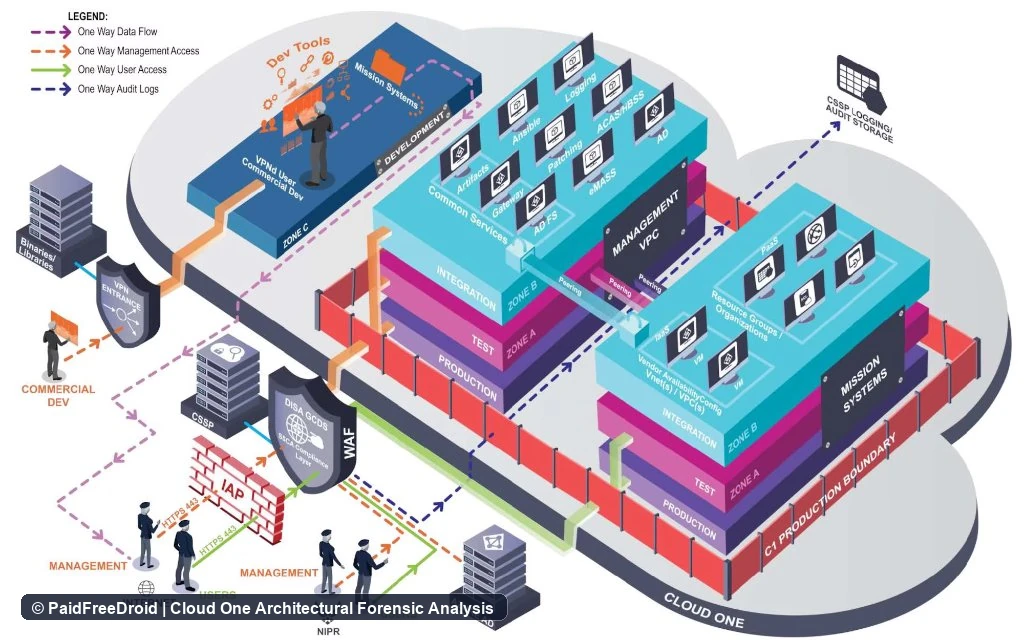
A forensic audit of the official Air Force Cloud One system architecture reveals why the control-plane compromise triggered such severe alarm across military commands:
- Three-Tiered Isolation (Zones A, B, and C): Development workloads originate in Zone C (commercial dev environment accessed via VPN entrance), before advancing through Zone B (Integration) and Zone A (Testing) toward the fortified C1 Production Boundary.
- Centralized Management VPC: Common enterprise services-including Ansible automated orchestration, ACAS/HBSS host security, eMASS compliance reporting, Active Directory Federation Services (AD FS), and centralized audit logging-are funneled through a central Management VPC that maintains direct peering connections into production IaaS and PaaS mission clusters.
- DISA GCDS and Boundary Protections: External user ingress is governed by DISA GCDS (Global Content Delivery Service), a Web Application Firewall (WAF), an Identity-Aware Proxy (IAP), and Cybersecurity Service Provider (CSSP) layers. When adversaries compromise the management peering plane during maintenance, they can theoretically bypass external perimeter filters and directly access mission data stores.
As documented in our analysis of the Microsoft M365 cloud infrastructure reliability overhaul, multi-cloud architectures create intricate shared-responsibility perimeters. When hackers breach administrative peering gateways, the geographic distribution across commercial hyperscalers fails to isolate lateral compromise.
| Mission Component | Cloud Environment | Military Operational Role | Breach Impact Rating |
|---|---|---|---|
| TICMS | Enterprise Multi-Cloud | Global munitions tracking (200+ bases) | Critical (Strategic Supply Chain) |
| CBC2 | Hyperscaler Fabric | North American air-defense radar feeds | Critical (Tactical Situational Awareness) |
| Fleet Maintenance | Commercial Hyperscalers | Combat aircraft readiness & spare parts | High (Operational Availability) |
| Enterprise Core | AWS & Azure Enclaves | Personnel records & military payroll | Moderate (Credential & Identity Exposure) |
Munitions Auditing and Radar Feeds: Why TICMS and CBC2 Are Critical Targets
The primary concern among defense analysts centers on the exposure of specialized tactical software systems hosted within Cloud One. The two most consequential platforms operating within the breached enterprise are TICMS and CBC2:
1. Theater Integrated Combat Munitions System (TICMS)
TICMS functions as the definitive global inventory ledger for every precision-guided bomb, air-to-air missile, warhead component, and ammunition pallet possessed by the U.S. Air Force. Modernized to replace paper manifests with tactical Getac tablets, TICMS delivers 100% real-time asset visibility across more than 200 operational air bases, forward operating depots, and ammunition bunkers worldwide.
If adversaries exfiltrated TICMS database tables, foreign intelligence services could map precise ordnance stockpiles, pinpoint critical supply-chain shortages for long-range standoff weapons, and track resupply cadences ahead of military contingencies.
2. Cloud-Based Command and Control (CBC2)
Engineered under the Pentagon’s Combined Joint All-Domain Command and Control (CJADC2) strategy, CBC2 microservices ingest, correlate, and visualize live radar telemetry from hundreds of military and civilian FAA radar arrays across North America. Supporting homeland defense operations under NORAD, CBC2 provides tactical operators with a unified aerospace common operating picture.
While weapon release commands operate on physically air-gapped tactical networks, control-plane reconnaissance against CBC2 data feeds could expose sensor blind spots, data transmission latency, and radar correlation algorithms.
Maintenance Window Exploitation: How Hackers Infiltrated Management VPC Backbones
Preliminary forensic findings indicate that threat actors struck during a scheduled platform maintenance and software upgrade window. Infrastructure maintenance periods represent the most vulnerable phase for enterprise cloud fabrics: security configurations are temporarily relaxed, continuous integration (CI/CD) pipelines execute elevated deployment scripts, and administrative accounts execute wide-ranging orchestration tasks.
This attack vector closely mirrors the intrusion tactics observed in the OPTIMJACK supply-chain cybersecurity breach, where threat actors bypassed external boundary firewalls by embedding exploits within routine management tools. Once inside Cloud One’s Management VPC, the attackers attempted to pivot through peering routes into active mission workloads, forcing Air Force cyber defenders to shut down remote updates and systematically flush administrative tokens.
Official Department of Defense Statement: “As a matter of policy, the Department of the Air Force does not comment on specific vulnerabilities, cyber incidents, or the operational posture of our networks. We continuously monitor and defend our enterprise systems against persistent threats, and mission-essential capabilities remain fully protected.”
Cyber Command Forensic Probe: Lateral Movement, Supply Chains, and Attribution
Forensic investigators from U.S. Cyber Command (CYBERCOM) and 16th Air Force are auditing server telemetry, egress traffic, and identity federation logs across AWS, Microsoft Azure, Google Cloud, and Oracle datacenters. Investigators are determining whether the breach resulted in passive reconnaissance, active database extraction, or the covert placement of dormant web shells for future activation.
The incident unfolds amid a coordinated wave of state-sponsored cyber operations targeting federal agency backbones, law enforcement networks, and telecommunications infrastructure. It follows the nationwide alert regarding the FBI National Crime Information Center database cyberattack probe, where sophisticated adversaries targeted centralized federal law enforcement databases. Investigators are assessing whether the Cloud One intrusion shares tactical signatures with known nation-state cyber warfare groups specializing in deep infrastructure pre-positioning.
Frequently Asked Questions: US Air Force Cloud One Cyberattack
What is the US Air Force Cloud One platform?
Cloud One is the U.S. Air Force’s primary enterprise multi-cloud computing environment, providing secure infrastructure across commercial hyperscalers including Amazon Web Services, Microsoft Azure, Google Cloud, and Oracle Cloud for unclassified and classified military workloads.
Were nuclear command or combat flight systems compromised?
No. Nuclear command, control, and communications (NC3) networks and active aircraft flight avionics operate on isolated, physically air-gapped tactical networks completely separated from enterprise cloud platforms.
What is TICMS and why is it strategically important?
The Theater Integrated Combat Munitions System (TICMS) is the digital asset management platform that inventories and tracks bombs, missiles, and ammunition components across more than 200 U.S. Air Force installations worldwide.
What emergency countermeasures were implemented?
Air Force cybersecurity teams revoked administrative privileges across the enterprise, paused active application migrations, froze routine software updates, and deployed U.S. Cyber Command to conduct deep forensic telemetry audits.
PFD Context: Consolidated Cloud Infrastructure Creates Single Failure Points
The Cloud One cyberattack exposes the central paradox of military cloud modernization. By migrating hundreds of fragmented, legacy on-premises servers into a consolidated commercial multi-cloud architecture, the Department of the Air Force gained vast computational efficiency, streamlined software delivery, and unified operational reporting across global commands.
However, enterprise consolidation inevitably creates an immensely attractive, centralized target for advanced adversaries. When an attacker breaches the control plane of a consolidated platform like Cloud One, the blast radius does not stop at office administrative tools; it simultaneously jeopardizes munitions accounting, air-defense radar feeds, and aircraft maintenance scheduling. As U.S. Cyber Command completes its investigation, this breach will accelerate congressional scrutiny over military dependency on commercial hyperscaler infrastructure and force an immediate shift toward strict, cryptographically isolated zero-trust architecture across all defense computing enclaves.
Stay Ahead in the Tech World
Join our community for breaking news, exclusive gadgets coverage & direct admin support.