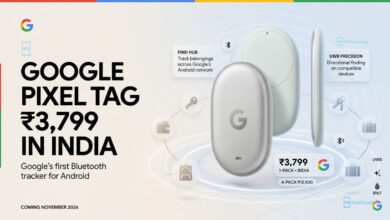





For years, Android users have watched with envy as Apple users enjoyed the seamless, highly precise item-tracking capabilities of the AirTag. Now, Google has finally answered the call. Unveiled at the recent Made by Google event, the Google Pixel Tag has officially launched in India, bringing Ultra-Wideband (UWB) precision and a massive crowdsourced network to the Android ecosystem.
With Apple also recently launching its 2nd Generation AirTag, the battle for your keychain and luggage is officially on. Here is the definitive PFD comparison of the Google Pixel Tag and the Apple AirTag, examining their design, tracking technologies, and exclusive ecosystem features.
Design, Build Quality, and Battery Life

Both tech giants have taken distinctly different approaches to the physical design of their trackers, though they share identical durability and battery metrics. A quick side-by-side comparison of the core specs reveals how closely matched they are.
- Form Factor: Apple AirTag retains its iconic circular, coin-like shape with a polished stainless steel finish. In contrast, the Google Pixel Tag adopts an oblong, pill-like shape constructed from a mix of polycarbonate and metal. The Pixel Tag is slightly flatter and feels noticeably thinner in the hand.
- Dimensions & Weight: Pixel Tag measures 46.1 x 28 x 5.4 mm and weighs 11.8g. AirTag measures 31.9 x 31.9 x 8.0 mm and is slightly lighter at 11g.
- Durability: Both devices carry a robust IP67 water and dust resistance rating, meaning they can survive immersion in up to 1 metre of water for 30 minutes.
- Battery Power: Thankfully, both trackers rely on a standard, user-replaceable CR2032 coin-cell battery. Both Apple and Google claim the battery will easily last for over one year of standard usage.

Tracking Technology: Find Hub vs. Find My
The true value of a smart tracker lies in the scale of the network backing it.
- Networks: The Apple AirTag operates on the Apple Find My network, utilizing over 1 billion active Apple devices globally. Pixel Tag operates on Google’s new Find Hub network, which similarly taps into an active network of over 1 billion Android devices globally to pinpoint lost items.

- Precision Finding Tech: Both trackers utilize Ultra-Wideband (UWB) technology to provide visual, metre-by-metre directional guidance when you are nearby. The 2nd Gen AirTag features an upgraded UWB chip (similar to the U2 chip) that provides up to 50% farther Precision Finding range compared to the 1st Gen model. The Pixel Tag pairs its UWB with new Bluetooth Channel Sounding technology, designed to provide distance readings accurate to the centimeter.
- Audio Alerts: Both trackers feature built-in speakers to play location chimes. The 2nd Gen AirTag boasts a speaker that is 50% louder than its predecessor.
Unique Ecosystem Features and Integrations
Beyond simple location tracking, each device leverages its respective ecosystem for unique capabilities.
- Pixel Tag’s Reverse Ringing: Unlike the featureless chassis of the AirTag, the Pixel Tag incorporates a physical multi-function button. Pressing this button will force your connected Android smartphone to ring loudly, even if the phone is set to silent – a highly requested feature that Apple users still lack.

- AirTag’s Airline Integration: Apple has deeply integrated the AirTag with over 50+ airlines. For example, Air India passengers can securely generate a “Share Item Location” link through the Find My app and submit it directly to the Air India Customer Support Portal to seamlessly track delayed baggage.
- Sharing Capabilities: Google built collaborative tracking directly into the Pixel Tag, allowing users to share a single tag’s real-time location with up to 10 people via the Find Hub app. Apple also supports the “Share Item Location” function through temporary links.
- Anti-Stalking: Both ecosystems have implemented strict anti-tracking protections. End-to-end encryption is standard, and cross-platform safety protocols mean both iOS and Android phones will natively alert users if an unknown Pixel Tag or AirTag is detected travelling with them.

Complete Specifications Comparison Matrix
| Specification | Google Pixel Tag | Apple AirTag (2nd Generation) |
| India Price (1-Pack) | ₹3,799 | ₹3,790 |
| India Price (4-Pack) | ₹12,900 | ₹12,900 |
| Tracking Network | Google Find Hub (Android Only) | Apple Find My (iOS Only) |
| Precision Tech | UWB + Bluetooth Channel Sounding | 2nd-Gen UWB Chip + Bluetooth |
| Dimensions | 46.1 x 28 x 5.4 mm | 31.9 x 31.9 x 8.0 mm |
| Battery Type | CR2032 (User-Replaceable) | CR2032 (User-Replaceable) |
| Durability Rating | IP67 Water/Dust Resistance | IP67 Water/Dust Resistance |
| Unique Hardware | Physical Button (Reverse Phone Ring) | Built-in NFC for Found Tag ID |
| Location Sharing | Share with up to 10 People | Temporary Secure Link Sharing |
| Customization | N/A | Free Text & Emoji Engraving |
PFD Context:
For years, buying a tracker in India was a fairly simple decision: iPhone owners bought an AirTag, and everyone else either did without or picked up a budget alternative out of convenience. With the launch of the Pixel Tag, the ecosystem walls have firmly been drawn. The question of “which is better” is entirely irrelevant because neither device works on the competing platform.
If you own a Samsung, Motorola, or Pixel phone, the Pixel Tag is an absolute triumph; the addition of a physical button to ring your misplaced phone is a massive hardware advantage.
Conversely, if you live in the Apple ecosystem, the 2nd Gen AirTag’s 50% longer tracking range and deep airline integration make it the undisputed king of luggage tracking. Pick the tag that matches your smartphone, as both deliver phenomenal, heavily encrypted tracking at virtually identical price points.
Tags: Google Pixel Tag vs Apple AirTag, Pixel Tag specs, AirTag 2nd Gen price India, Find Hub vs Find My, Ultra-Wideband tracker, tech comparison 2026
Visit our website daily for latest tech news. Follow Us on Instagram for awesome tech stuff. Also, Join our Telegram Group and connect directly with Admin.