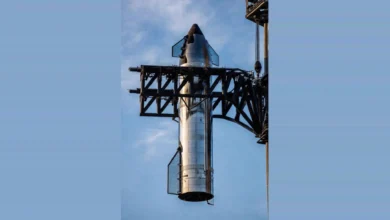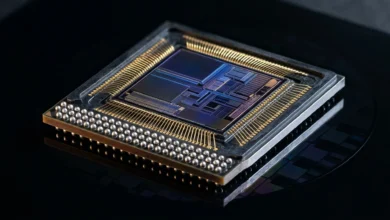
Modern military confrontation is no longer measured solely in carrier strike groups, ballistic throw-weights, or mechanized armored divisions. Across the Persian Gulf, the Strait of Hormuz, and the skies of the Levant, the strategic standoff between the United States and the Islamic Republic of Iran has shifted into a silent, lethal competition waged across the electromagnetic spectrum and commercial semiconductor supply chains. This is the silicon battlefield: an arena where $20,000 attack drones built with smuggled civilian microcontrollers challenge multibillion-dollar naval flotillas, where ground-based electronic warfare arrays corrupt international aviation corridors, and where low-Earth orbit satellite constellations fight real-time telemetry duels against state-level electronic spoofing.
Three technological pillars define this new operational reality: widespread global positioning system (GPS) manipulation that blinds civilian airliners and guided munitions alike, the weaponization of commercial off-the-shelf (COTS) semiconductors inside long-range loitering munitions, and the contested deployment of SpaceX Starlink satellite terminals operating inside Iranian borders. By examining forensic hardware teardowns, satellite telemetry logs, and the brutal economic disparity of modern air defense, the technological mechanics of 21st-century proxy warfare come sharply into focus.
Tactical Hardware: Air Defense, Loitering Munitions, and Satellite Terminals
To grasp how consumer technology merged with modern warfare, observe the three primary physical assets clashing across the Middle Eastern theater: mass-produced Iranian delta-wing drones, American guided-missile air defense destroyers, and low-Earth orbit phased-array satellite terminals deployed by civilians and defense agencies:
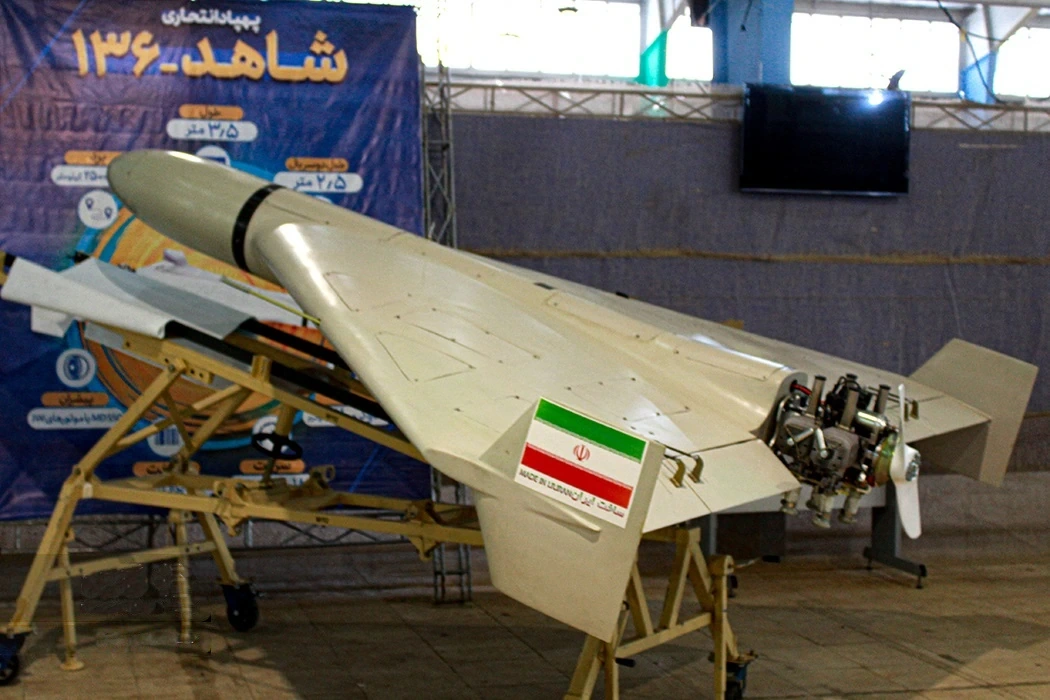


These systems represent starkly contrasting defense philosophies. The Iranian Shahed loitering munition relies on distributed, cheap, commercial microelectronics assembled in underground workshops to achieve saturation through mass. The US Navy Arleigh Burke-class destroyer, such as the USS Carney, deploys some of the most sophisticated, high-cost radar and kinetic interceptor systems on earth to protect international shipping lanes. Meanwhile, commercial satellite constellations like Starlink provide high-bandwidth low-Earth orbit communications that bypass state-controlled terrestrial telecommunications entirely.
Electromagnetic Navigation Warfare: The Invisible GPS Spoofing Grid
For decades, satellite-based navigation was treated as an unassailable global utility. Today, the airspace stretching from the eastern Mediterranean to the Strait of Hormuz has become an active electronic testing ground, where civilian airliners and military assets regularly lose satellite lock or find their instruments broadcasting completely fabricated coordinates.
Electronic warfare operators distinguish between three distinct tiers of electromagnetic interference: radio frequency (RF) noise jamming, signal meaconing, and coordinated coordinate spoofing:

While simple jamming merely drowns satellite receivers in electromagnetic noise (causing pilots or autopilots to revert to inertial navigation systems), spoofing is far more insidious. High-power ground transmitters broadcast synthetic radio signals on the GPS L1 (1575.42 MHz) and L2 (1227.60 MHz) frequencies. Because genuine satellite signals travel over 20,000 kilometers from medium-Earth orbit, their received signal strength at ground level is exceptionally faint: typically around -130 dBm, equivalent to observing a 25-watt lightbulb from hundreds of miles away.
A ground-based electronic warfare transmitter operating at dozens or hundreds of watts easily overwhelms genuine satellite signals. Rather than dropping connection, an aircraft or drone receiver locks onto the stronger counterfeit signal. By slowly manipulating the timestamp and orbital ephemeris data embedded in the transmission, the attacking station can deceive the navigation computer into believing it is miles away from its true physical location.
The real-world consequences for commercial aviation have been severe. International airline crews transiting flight corridors near Baghdad, Cairo, and the Persian Gulf have reported incidents where aircraft navigation systems registered positions hundreds of miles off course, triggered false terrain-avoidance warnings, and initiated unauthorized automated turns toward hostile airspace. In the maritime domain, commercial oil tankers transiting the Strait of Hormuz have reported false coordinate loops placing them inside Iranian territorial waters, creating artificial legal pretexts for maritime interdiction by the Islamic Revolutionary Guard Corps Navy (IRGCN).
Microchip Teardowns: Smuggled Western Silicon Inside Iranian Drones
Despite decades of comprehensive sanctions administered by the US Department of the Treasury’s Office of Foreign Assets Control (OFAC) and strict export restrictions enforced by the Bureau of Industry and Security (BIS), Iran has engineered an expansive drone arsenal. The technical foundation of this capability was laid bare through exhaustive physical teardowns conducted by independent weapons monitoring organizations, notably Conflict Armament Research (CAR), alongside allied intelligence agencies analyzing downed Shahed-136, Mohajer-6, and Qods airframes.
The forensic findings revealed a stunning technological reality: over 80 percent of the microprocessors, analog-to-digital converters, and RF modules recovered inside Iranian military drones originated from Western semiconductor manufacturers, primarily based in the United States, Switzerland, Germany, and Japan.
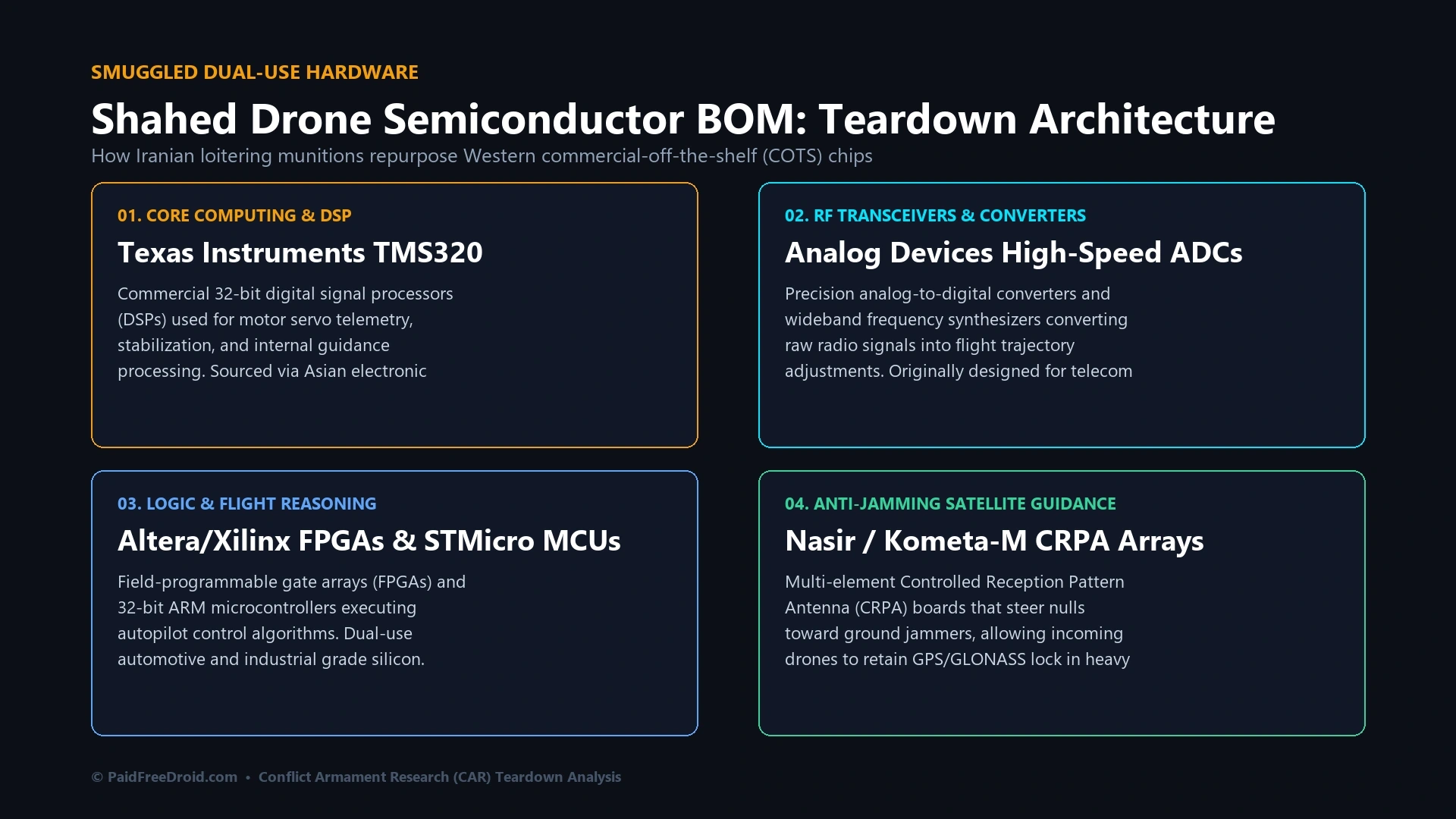
The architectural breakdown of an Iranian Shahed-136 loitering munition reveals how commercial off-the-shelf (COTS) chips are repurposed for lethal military guidance:
| Subsystem | Component Function | Recovered Semiconductor / Module | Primary Commercial Origin | Civilian Application |
|---|---|---|---|---|
| Core Signal Processing | Motor telemetry, guidance calculations & servo loops | Texas Instruments TMS320 Series DSP | United States | Automotive engine control, industrial robotics |
| RF Signal Digitization | High-speed analog-to-digital frequency conversion | Analog Devices AD9218 / AD9361 Transceiver | United States | 4G/5G cellular base stations, medical imaging |
| Flight Autopilot & Logic | Autopilot execution & mission sequencing | STMicroelectronics STM32F4 32-bit ARM MCU | Switzerland / EU | Smart appliances, 3D printers, consumer drones |
| Programmable Gate Logic | High-speed bus routing & custom sensor fusion | Altera / Xilinx Spartan-6 & Artix-7 FPGAs | United States | Automotive radar, telecom routing, factory automation |
| Satellite Receiver | Multi-constellation GNSS signal acquisition | Custom Nasir / Kometa-M with Western RF Front-Ends | Iran / Russia (with Western chips) | High-precision surveying, marine navigation |
| Power Regulation | Voltage stepping, clean power distribution to servos | Linear Technology / Maxim Integrated LDOs | United States | Consumer laptops, industrial power supplies |
The presence of these components highlights the fundamental challenge of modern multilateral export control regimes. These chips are not classified as specialized military-grade munitions subject to the International Traffic in Arms Regulations (ITAR). Instead, they are dual-use commercial items produced in volumes of hundreds of millions annually. Iranian state procurement networks exploit this ubiquity through complex, multi-tiered front companies operating across Dubai, Hong Kong, Turkey, and Central Asia.
A shell company in the United Arab Emirates orders standard industrial microcontrollers under the guise of servicing agricultural pumps or consumer appliances. The shipment is routed through freight forwarders in Southeast Asia before being quietly transshipped to Tehran. By the time Western regulatory authorities identify the intermediary entity, the corporate shell is dissolved and reconstituted under a new corporate registration. As we explored in our investigation of semiconductor export control scrutiny and dual-use supply chains, stopping the physical leakage of standardized civilian silicon across globalized commercial distribution channels remains nearly impossible.
Starlink Under Fire: Phased-Array Antennas and InhibitGPS Telemetry
While Iranian loitering munitions leverage Western microchips in external theaters, an equally fierce technological battle has erupted within Iranian borders. During nationwide public protests and state-enforced telecommunications shutdowns, thousands of smuggled SpaceX Starlink user terminals were brought across western borders via clandestine courier routes, establishing an uncensored communications backbone for activists, journalists, and citizens.
Because the Iranian Ministry of Information and Communications Technology cannot easily sever low-Earth orbit satellite links using standard national firewall blocks or terrestrial cable cuts, state electronic warfare battalions turned to high-powered radio frequency interference. Specifically, Iranian units deployed ground-based GPS spoofing arrays around major metropolitan hubs to disrupt Starlink dish pointing.
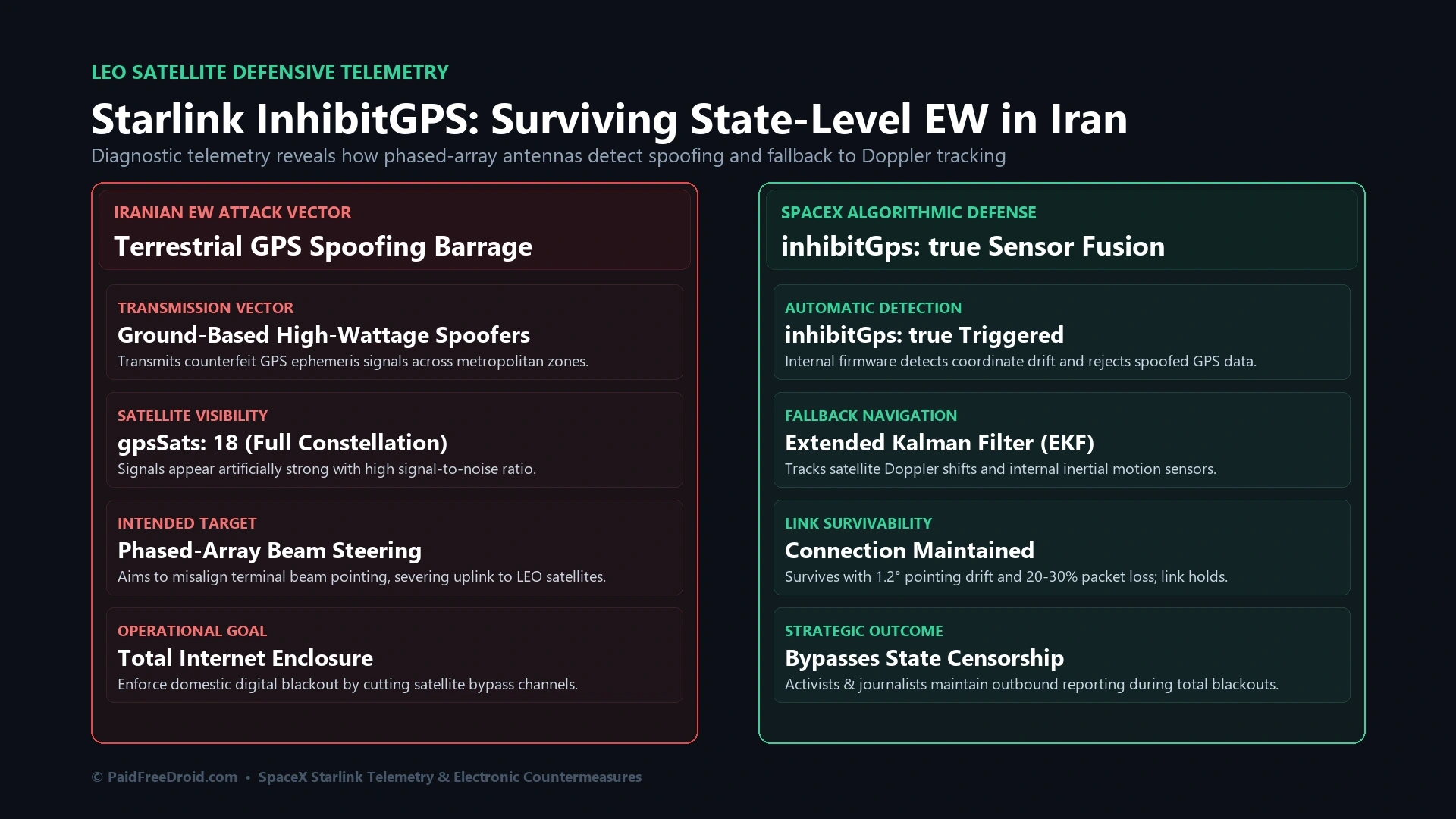
Unlike traditional parabolic satellite dishes that remain stationary, a Starlink user terminal relies on an active electronically scanned array (AESA) consisting of hundreds of tiny antenna elements. To maintain a gigabit link with Starlink satellites streaking across low-Earth orbit at 27,000 kilometers per hour, the terminal must calculate the precise orbital ephemeris of approaching satellites and steer radio beams across the sky in milliseconds.
To execute this rapid beam-forming, the terminal requires absolute certainty regarding its own geographic coordinates and nanosecond-level time synchronization. Technical telemetry extracted from Starlink terminals operating inside Iran revealed a fascinating diagnostic signature: diagnostic logs displayed an active inhibitGps: true flag alongside a healthy constellation count of gpsSats: 18.
This signature proved that SpaceX’s embedded software detected the terrestrial spoofing attack. The terminal recognized that incoming GPS signals, despite exhibiting strong signal-to-noise ratios, were broadcasting mathematically impossible coordinate jumps or inconsistent clock drifts. Rather than allowing false telemetry to misdirect its phased-array beams, the terminal rejected the compromised GPS data entirely.
Once GPS was inhibited, the dish fell back to an internal sensor-fusion system powered by an Extended Kalman Filter (EKF). The terminal estimated its relative position by analyzing the Doppler-shift frequency changes of incoming Starlink Ku-band downlink signals as satellites traversed overhead, cross-referencing this data with internal inertial measurement units. While this fallback introduced a minor beam pointing drift of 1.0 to 1.2 degrees and elevated packet loss to between 20 and 35 percent, the connection survived, frustrating state efforts to enforce a total digital blackout.
The strategic deployment of commercial satellite constellations across contested airspace reflects a wider transformation in global telecommunications, as analyzed in our report on global satellite communications and LEO spectrum licensing. When sovereign nations attempt to control information flows through territorial network gateways, mega-constellations operating in low-Earth orbit render traditional censorship architectures obsolete.
Asymmetric Attrition Economics: $20,000 Drones vs $3,000,000 Interceptors
Beyond the technical battle of algorithms and frequencies lies the most alarming dimension of the silicon battlefield: the brutal economic imbalance of modern air defense. In maritime engagements across the Red Sea, the Gulf of Aden, and the Persian Gulf, US Navy carrier strike groups and allied warships have intercepted hundreds of Iranian-designed loitering munitions and anti-ship cruise missiles. While these interceptions demonstrate exceptional tactical proficiency, the underlying attrition curve is mathematically unsustainable.
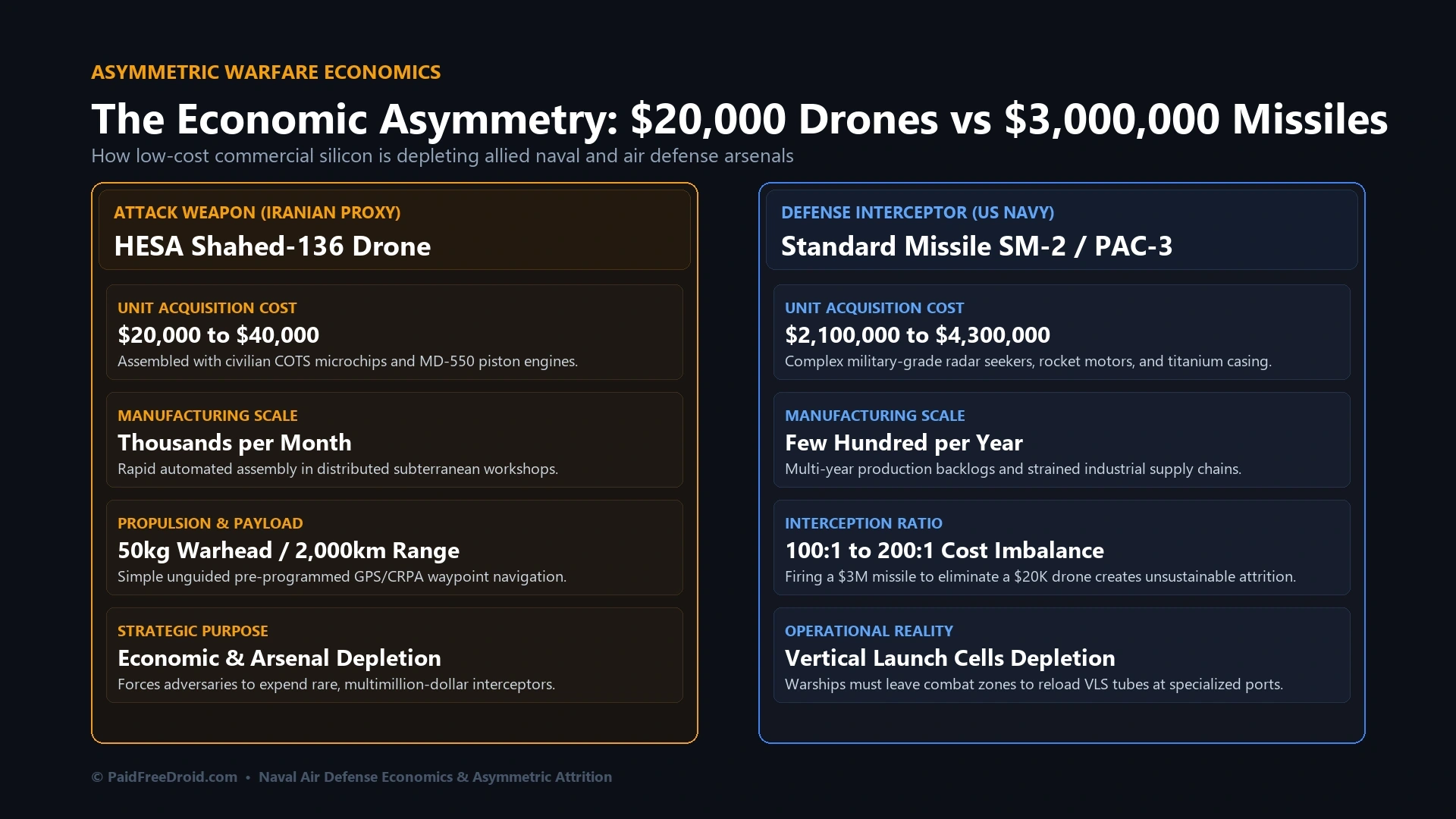
Consider the stark economic ledger of modern naval combat. An Iranian-designed Shahed-136 costs approximately $20,000 to $40,000 to manufacture. It is powered by a reverse-engineered MD-550 four-cylinder two-stroke piston engine, housed in a simple fiberglass-honeycomb airframe, and guided by commercial semiconductors procured from consumer supply chains. Iran and its regional proxies can manufacture thousands of these airframes every year in distributed underground workshops.
To intercept a single incoming drone flying toward a commercial shipping convoy or a naval asset, a US Navy guided-missile destroyer typically launches a Standard Missile-2 (SM-2) costing approximately $2.1 million, an Evolved SeaSparrow Missile (ESSM) costing $1.8 million, or an advanced Standard Missile-6 (SM-6) exceeding $4.3 million. Even when land-based Patriot air defense batteries (PAC-2 and PAC-3) are engaged, interceptor costs range between $3.5 million and $5.0 million per shot.
This creates a cost exchange ratio between 100:1 and 200:1 in favor of the attacker. Defending against a swarm of twenty drones costing $400,000 can exhaust $60 million worth of advanced naval interceptors in under fifteen minutes. Furthermore, naval Vertical Launch System (VLS) cells cannot be reloaded at sea. Once a destroyer empties its 96 VLS tubes in combat, it must disengage from the theater and transit to specialized naval ports for crane-assisted rearmament, leaving maritime task forces vulnerable to subsequent saturation waves.
Strategic Outlook: Directed Energy, Autonomous Vision, and Future Spectrums
The silicon battlefield between the United States and Iran has permanently altered the trajectory of modern military doctrine. As legacy electronic warfare and kinetic air defenses reach their economic and physical limits, both sides are rapidly iterating their technological architectures.
On the offensive side, Iranian weapons designers are systematically mitigating their reliance on vulnerable satellite navigation. Newer iterations of Shahed drones have begun integrating multi-element Controlled Reception Pattern Antennas (CRPA), such as the indigenous Nasir array, which electronically shapes reception patterns to ignore jamming signals arriving from the horizon. More critically, developers are transitioning toward low-cost optical scene-matching systems, utilizing edge AI microprocessors to navigate visually against satellite terrain imagery without emitting or receiving radio signals.
On the defensive side, the US military and allied nations are racing to field non-kinetic countermeasures that flip the economic equation. High-energy laser weapon systems (such as the Navy’s HELIOS laser) and high-power microwave (HPM) emitters offer per-shot interception costs measured in dollars rather than millions, provided they can overcome atmospheric scattering and thermal blooming. Concurrently, electronic warfare units are deploying advanced cognitive radar and AI-driven jamming systems capable of dissecting drone control links autonomously.
The conflict in the Middle East has proven that the decisive frontier of modern warfare is no longer defined by heavy industrial armor or sheer tonnage. It is defined by who controls the radio frequencies, who secures the semiconductor supply chains, and whose software algorithms adapt fastest when the satellite signals disappear.
Stay Ahead in the Tech World
Join our community for breaking news, exclusive gadgets coverage & direct admin support.