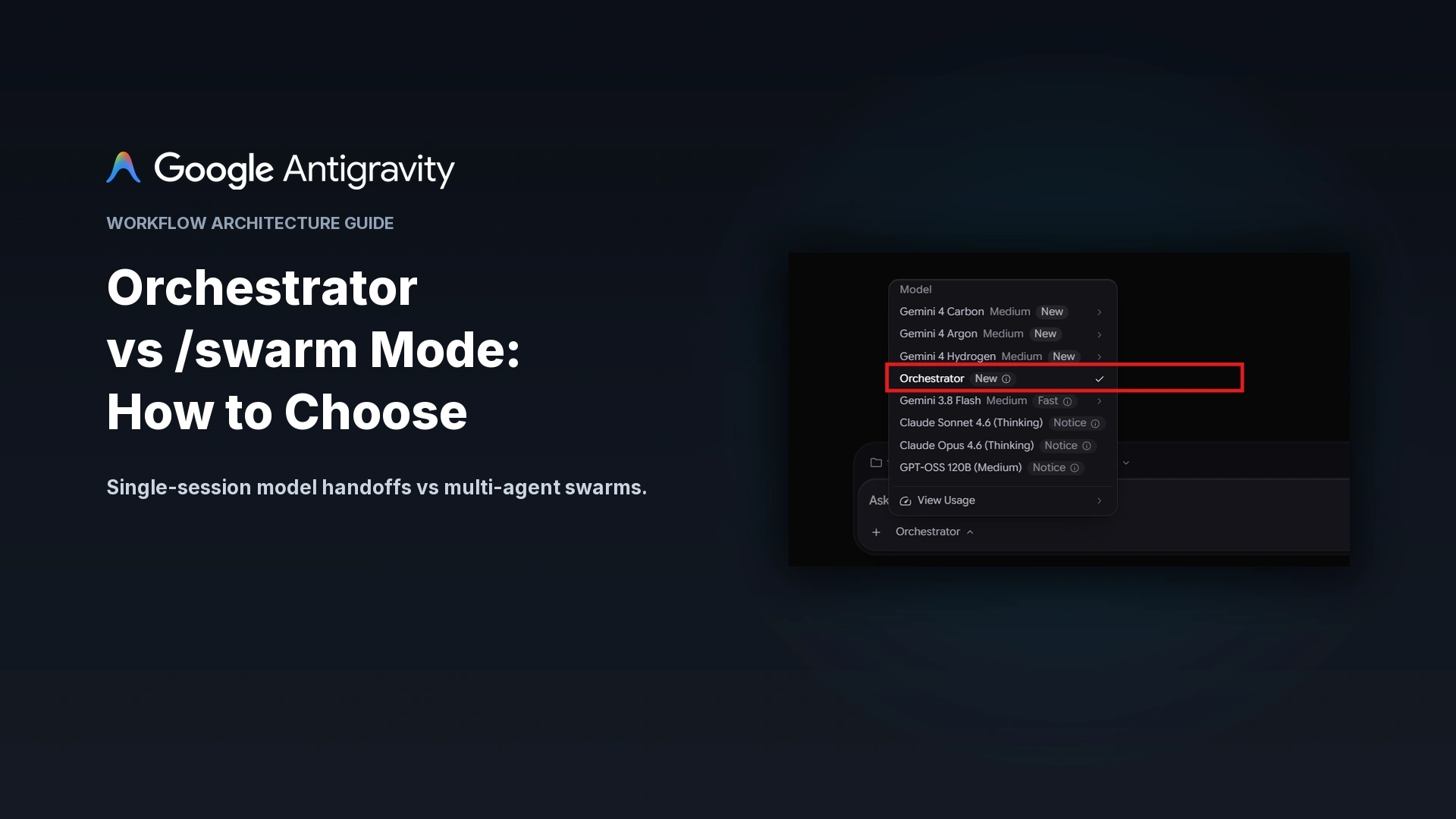
Google Antigravity expanded its agentic developer stack with two distinct operational workflows: Orchestrator mode and native Swarm mode. While developers frequently conflate both features, their operational design addresses opposing software engineering challenges. Orchestrator operates as a single engineer dynamically switching between cognitive models within a single thread, whereas Swarm functions as a multi-agent engineering department running asynchronous tasks across isolated Git worktrees.
Operational Trade-Offs: Token Consumption vs Context Complexity
Selecting between single-threaded orchestration and multi-agent swarms requires balancing token expenditure against task isolation. Orchestrator preserves quota efficiency by maintaining linear conversation state and delegating boilerplate tasks to lightweight models. In contrast, Swarm prioritizes wall-clock execution speed by spawning independent subagents across dedicated branches. However, running simultaneous worker and verifier instances dramatically accelerates token consumption, making swarms uneconomical for simple, tightly coupled script modifications.
Key Architectural Pillars: Dynamic Handoffs vs Parallel Swarms
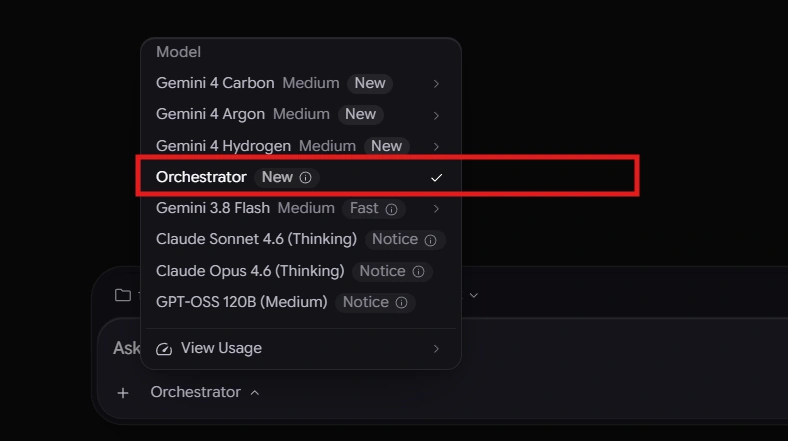
- Orchestrator Mode Model Switching: Activated via the model selector dropdown, Orchestrator delegates complex planning to reasoning models like Gemini 4 Carbon, drops to fast execution models like Gemini 4 Hydrogen for boilerplate code, and returns execution errors to advanced models for reassessment.
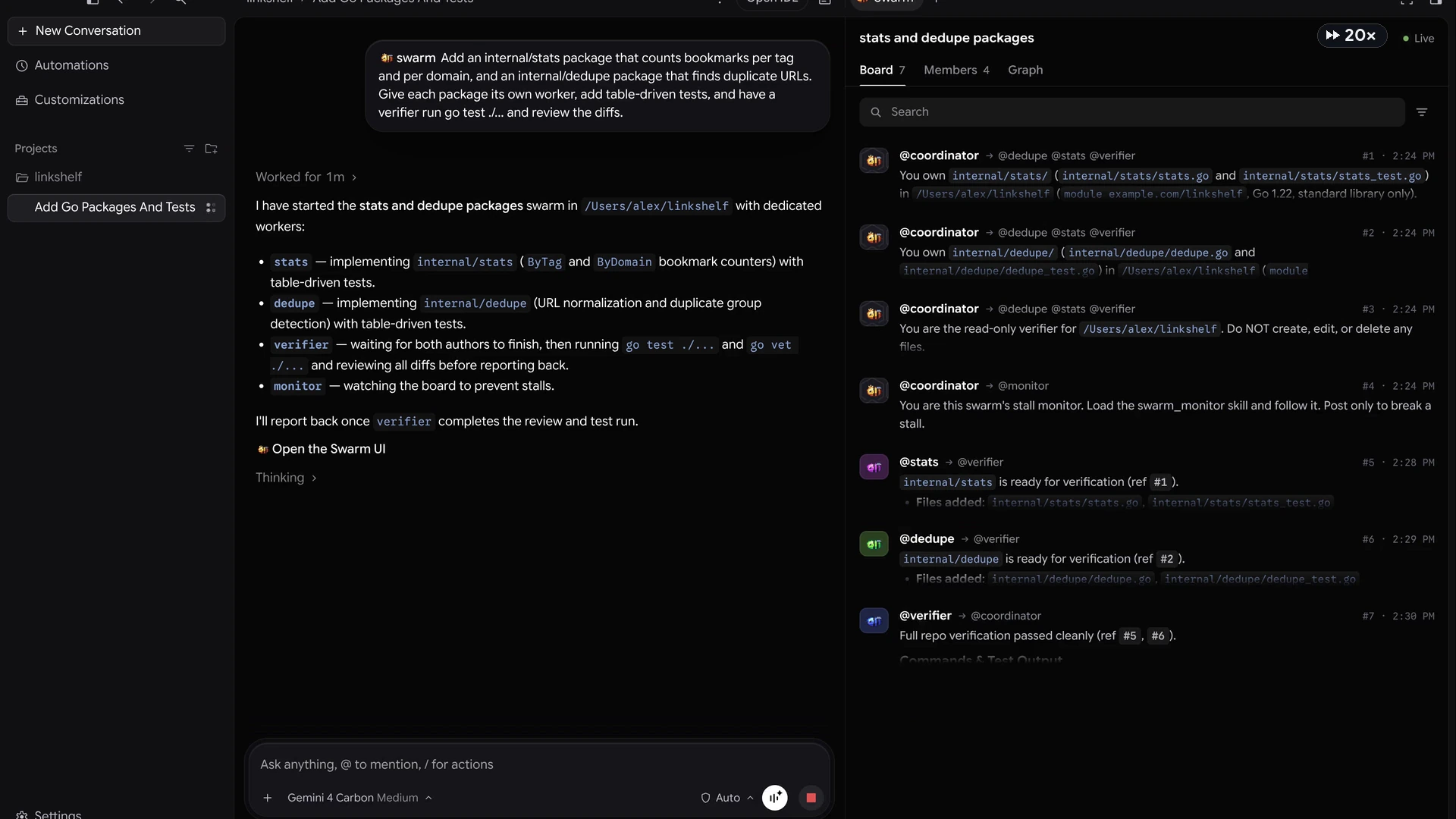
- Swarm Mode Multi-Agent Dispatch: Triggered via the /swarm command, the primary thread acts as an architectural Coordinator that assigns tasks, delegates implementation to isolated Worker agents, and monitors progress via a shared message board.
- Worktree Workspace Isolation: Swarm workers edit source code inside distinct Git worktrees without colliding, while Orchestrator operates directly inside a single active repository directory.
- Independent Verification Safeguards: Swarm decouples implementation from review by assigning dedicated Verifier agents to execute automated test suites, ensuring no single model acts simultaneously as author and reviewer.
Orchestrator vs Swarm Mode: Architectural Feature Comparison
Evaluating core mechanics reveals how both Antigravity execution modes serve distinct development phases:
| Operational Dimension | Orchestrator Mode | Swarm Mode (/swarm) |
|---|---|---|
| Execution Architecture | Single-threaded dynamic handoffs | Multi-agent asynchronous parallel execution |
| Invocation Interface | IDE model dropdown selector | Slash command prompt (/swarm) |
| Workspace Isolation | Single shared working copy | Isolated Git worktrees per worker |
| Model Specialization | Dynamic Carbon and Hydrogen shifts | Assigned specialist roles (Worker, Verifier) |
| Token Economy | Quota-conserving single session | High-throughput multi-agent token usage |
| Verification Method | Single-model inline test loops | Dedicated read-only adversarial Verifiers |
| Ideal Development Task | Single-module refactor, bug isolation | Multi-file migrations, parallel features |
Strategic Implementation: How to Combine Both Modes in Production
Production engineering teams extract maximum value by chaining both Antigravity capabilities together. Developers should maintain Orchestrator as their default environment for day-to-day feature planning, dependency debugging, and single-file refactoring. When a monolithic bottleneck or massive test matrix arises, engineers can dispatch a parallel Swarm to complete multi-module changes across isolated branches before merging the validated diff back into the primary session. Readers tracking Google developer tooling can explore our Gemini 4 Carbon architecture report, review our Gemini 4 Hydrogen coding benchmarks, or inspect our Gemini Decision 1 routing analysis.
Stay Ahead in the Tech World
Join our community for breaking news, exclusive gadgets coverage & direct admin support.