Millions of bank accounts in India lie inactive for decades. Relatives move cities, elderly parents open term deposits without informing nominees, or people lose track of secondary accounts opened for old jobs. When a savings, current, or fixed deposit account sees zero customer-induced activity for ten continuous years, Indian banking regulations require commercial banks to classify the balance as an unclaimed deposit.
These forgotten funds are never forfeited. The Reserve Bank of India (RBI) operates a dedicated centralized discovery platform called UDGAM (Unclaimed Deposits: Gateway to Access inforMation). Whether you are looking for your own long-forgotten savings or locating deposits left behind by deceased family members, this guide explains how the RBI DEA Fund works, how to search the UDGAM portal step by step, and how to settle your claim directly with the bank.
What Is an Unclaimed Bank Deposit and the RBI DEA Fund?
Under Section 26 of the Banking Regulation Act, 1949, any deposit balance untouched for ten or more years is deemed inoperative. To protect depositor interests and prevent banks from absorbing forgotten funds into operational revenue, the RBI established the Depositor Education and Awareness (DEA) Fund under Section 26A of the Act in 2014. At the end of every calendar month, banks calculate all eligible 10-year dormant accounts and transfer the principal balance plus accrued interest to the DEA Fund.
According to official disclosures by the Ministry of Finance, more than ₹78,000 crore currently sits unclaimed across public and private sector banks in India. Transferring money to the DEA Fund does not strip away legal ownership. Depositors, legal heirs, and registered nominees retain the permanent right to reclaim their funds from the bank at any point in time, even decades after the transfer occurred.
Furthermore, money transferred to the DEA Fund continues earning interest. The RBI mandates that unclaimed deposits continue to accrue interest during their stay in the fund. For savings and fixed deposit accounts transferred to the DEA Fund, the RBI currently credits interest at 3 percent simple interest per annum, payable from the date of transfer until the date of final claim settlement. Similar to national frameworks protecting consumer rights under RBI regulatory safeguards for digital banking, UDGAM ensures that legacy account records remain traceable and recoverable.
Step 1: Register and Access the RBI UDGAM Portal
The UDGAM portal is completely free to use. It never asks for your bank account passwords, debit card numbers, or UPI PINs. To access the search engine, you must first create a registered user profile linked to your active mobile number.

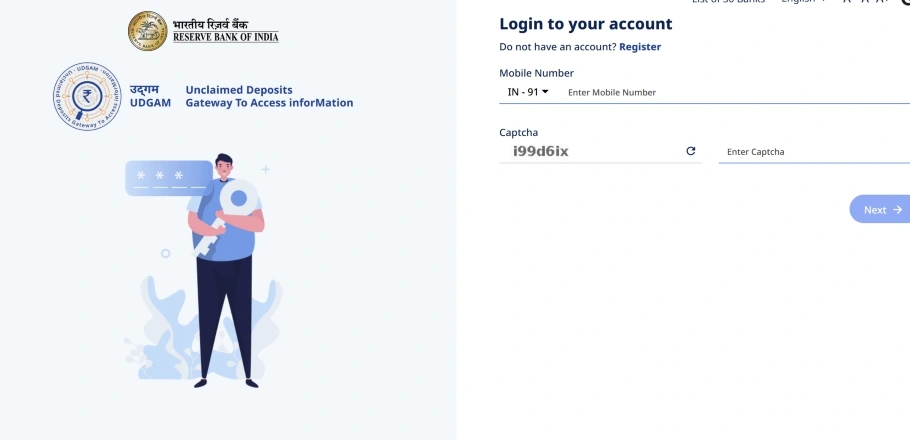
Open your browser and navigate directly to the official portal: https://udgam.rbi.org.in/. On the welcome page, select your preferred language (English or Hindi). If visiting for the first time, click the Register button located beneath the login box.

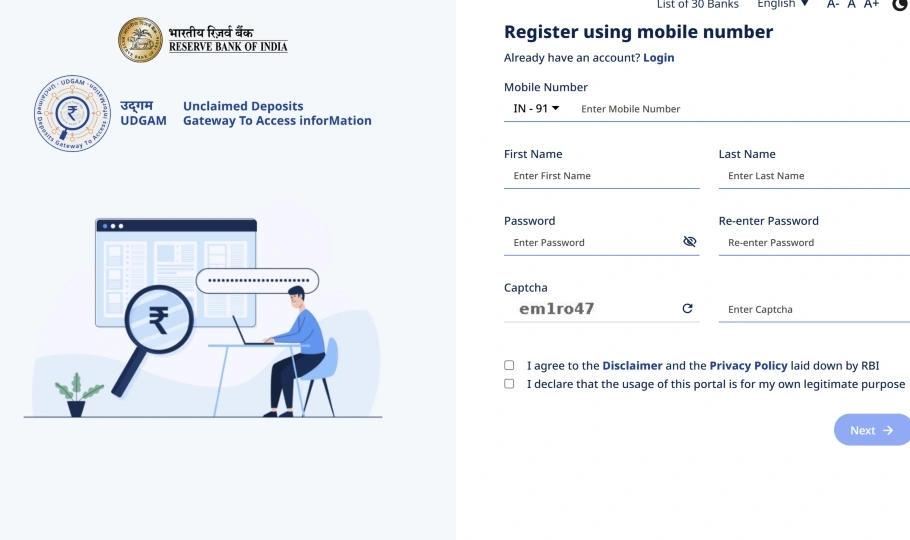
The registration form requires the following details:
- Mobile Number: An active 10-digit Indian mobile number to receive SMS OTPs.
- First and Last Name: Your personal legal name. This is for portal access and does not have to match the lost account holder.
- Password: Minimum 8 characters including uppercase, lowercase, a number, and a special symbol.
- Captcha Code: Enter the alphanumeric security captcha shown on screen.
- Declarations: Check the two declaration boxes agreeing to terms of use and confirming lawful data access.
Click Next and enter the OTP received on your phone. Once verified, return to the home screen and log in using your registered mobile number and password, or choose direct OTP login. Note that the RBI limits each profile to 10 logins per calendar day and 10 search queries per active session.

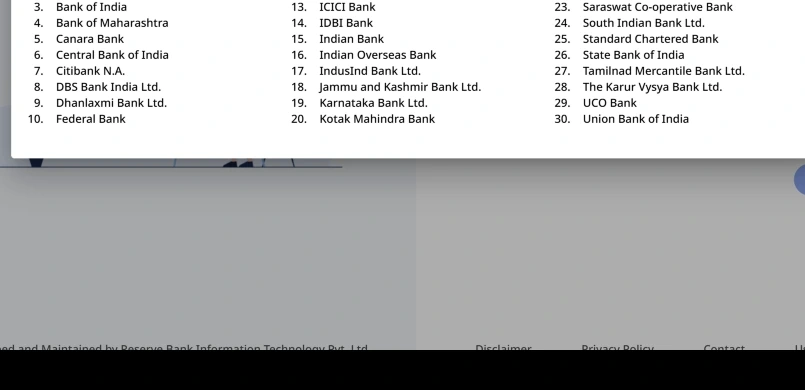
UDGAM currently integrates 30 major banks representing over 90 percent of all unclaimed deposits in India. This roster includes public sector lenders (State Bank of India, Punjab National Bank, Bank of Baroda, Canara Bank), major private institutions (HDFC Bank, ICICI Bank, Axis Bank, Kotak Mahindra Bank), foreign banks operating in India (Citibank, HSBC, Standard Chartered), and leading regional rural banks.
Step 2: Search for Inactive Accounts and Generate Your UDRN
Once logged in, the search console displays two tabs: Individual (for personal savings, recurring deposits, and fixed deposits) and Non-Individual (for commercial companies, partnerships, trusts, and sole proprietorships).

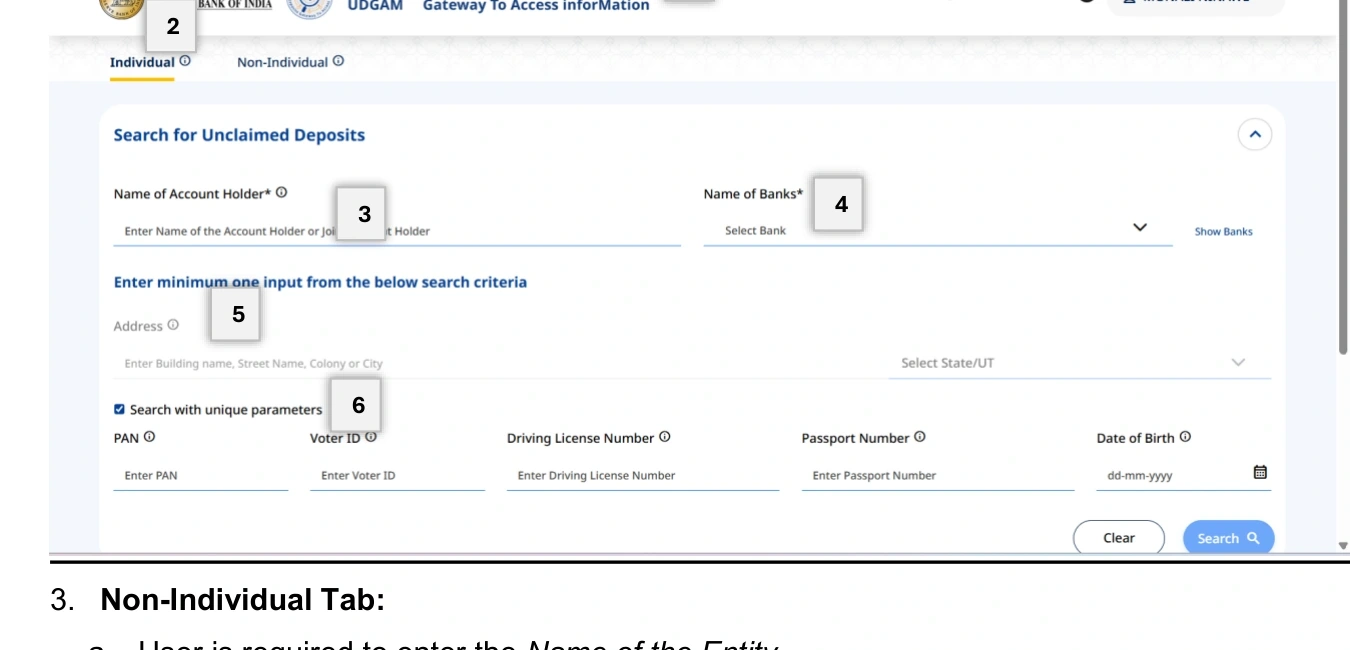
To run an accurate query, provide the following search parameters:
- Name of the Account Holder (Mandatory): Enter the full legal name of the person whose account you are searching for. If searching for a deceased relative, enter their name as recorded on older official papers or land records.
- Select Bank: You can select a single specific bank from the dropdown list, or choose Select All to simultaneously query all 30 participating financial institutions across India.
- Secondary Identifying Criteria (At Least One Recommended): While name alone is allowed, entering name across common Indian names may return dozens of unrelated records. Narrow your search by entering at least one of the following filters:
- Permanent Account Number (PAN)
- Voter Identity Card Number (EPIC)
- Passport Number
- Driving Licence Number
- Date of Birth (DD/MM/YYYY)
- Registered Residential Address
Click the Search button. The portal transmits the encrypted query to the Core Banking Solutions (CBS) of all selected institutions.

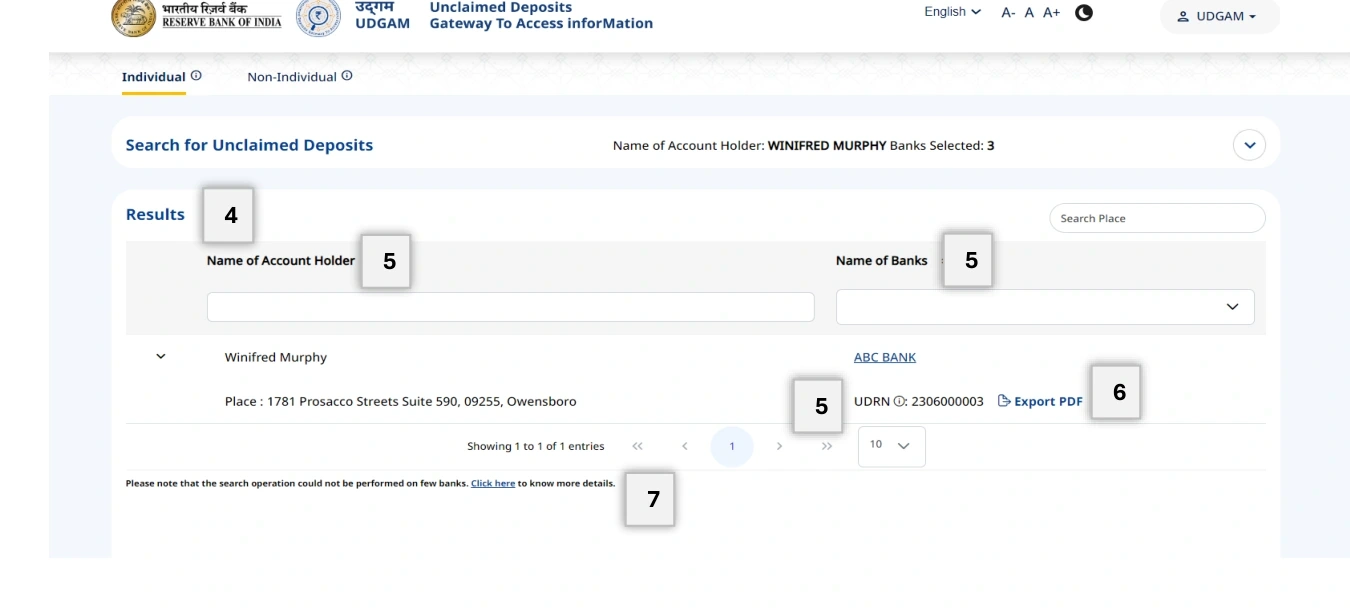
When a record matches your query, the portal outputs an organized search results grid. For security and privacy, UDGAM does not display the exact financial balance on screen. Instead, the results grid provides three vital operational details:
- Bank Name and Branch Details: The exact banking institution and the home branch where the deposit was opened.
- Account Holder Name and Masked Address: Confirms the identity of the account holder alongside masked residential address details.
- Unclaimed Deposit Reference Number (UDRN): A unique alphanumeric tracking code generated by the bank core banking database. The UDRN serves as the official master reference key for your claim.
Click the Download PDF button at the top right of the results table. Save this document securely, as you will need it when submitting settlement paperwork to the bank.
Step 3: How to Settle Your Claim with the Bank (Self vs Legal Heirs)
A crucial distinction to understand is that UDGAM is an information discovery service, not a direct payout window. The RBI does not disburse funds directly from the website. To collect your money, you must present the generated UDRN to the respective commercial bank. The procedure depends on whether you are claiming your own funds or claiming on behalf of a deceased relative.
| Claim Category | Mandatory Documents Required | Settlement Method |
|---|---|---|
| Original Account Holder (Self) | UDRN printout, PAN card, Aadhaar card, recent passport photograph, old passbook/cheque/FD receipt (if available). | Account reactivation or direct NEFT transfer to active bank account. |
| Registered Nominee | UDRN printout, original Death Certificate of account holder, Nominee KYC documents, bank claim form. | Direct payment via NEFT/RTGS or demand draft within 15 days. |
| Legal Heir (No Nomination) | UDRN printout, Death Certificate, Legal Heir Certificate / Succession Certificate, Indemnity Bond, KYC of all legal heirs. | Disbursement shared among verified legal heirs as per legal succession. |
Here is how to complete the claim process based on your scenario:
Scenario 1: Claiming Your Own Inactive Account
Visit the home branch identified in your UDRN summary, or visit any operational branch of the same bank. Request the Inoperative Account / Unclaimed Deposit Claim Form. Submit the filled form with self-attested copies of your PAN, Aadhaar, and recent photographs. The branch will execute fresh Know Your Customer (KYC) verification. Once your identity matches the historical ledger, you can reactivate the account by making a fresh deposit or debit transaction, or close the account and receive the full balance with accumulated interest credited to your active bank account via NEFT. For broader context on modern digital financial services, read our guide on digital payment systems in India.
Scenario 2: Claiming as a Registered Nominee
If the original account holder is deceased and you were registered as the official nominee, the settlement is straightforward. Visit the branch with the original Death Certificate of the deceased account holder, your own photo identity and address proofs, and the bank standard deceased claim form. Under RBI regulations, banks must settle undisputed nominee claims within 15 working days of receiving complete documentation.
Scenario 3: Claiming as Legal Heirs (Without Prior Nomination)
If no nominee was registered on the account, the legal heirs must file a joint claim. In addition to the Death Certificate and personal KYC documents, the bank requires a Legal Heir Certificate issued by the local revenue authority (such as the Tahsildar or Taluk Magistrate) or a formal Succession Certificate issued by a civil court for larger deposit values. If multiple legal heirs exist, other heirs can submit a notarized No Objection Certificate (NOC) relinquishing their claim in favor of one individual, or authorize a joint disbursement. Banks also require an Indemnity Bond stamped as per state stamp duty regulations to protect against third-party disputes.
For more verified digital tools and public resources that simplify everyday tasks, explore our guide to essential online utilities and tools.
Frequently Asked Questions About RBI UDGAM and Unclaimed FDs
Does money lying in the RBI DEA Fund earn interest?
Yes. Funds transferred to the DEA Fund earn 3 percent simple interest per annum, credited by the RBI until the final claim settlement date. The total disbursement includes both the original principal balance and the interest accrued during its stay in the fund.
Can I claim my money if I have lost the original passbook or FD certificate?
Yes. Physical passbooks, cheque books, and deposit certificates are secondary supporting evidence. Lack of physical paper does not disqualify a valid claim. The bank verifies ownership using permanent KYC credentials (PAN, Aadhaar, signature match) linked to the UDRN in their core banking database.
What should I do if my bank is not listed on UDGAM?
UDGAM covers 30 major banks representing over 90 percent of all unclaimed deposits. If your account was held with an unlisted urban cooperative bank or local regional lender, visit that specific bank official website. Under RBI guidelines, every licensed bank in India must maintain a dedicated, searchable Unclaimed Deposits page on its web portal.
How long does a bank take to process an unclaimed deposit claim?
For original account holders completing fresh KYC, claim approval and account reactivation typically take between 3 to 7 working days. For deceased depositor claims with clear nomination, RBI mandates completion within 15 days. Complex legal heir cases requiring legal heir validation or succession certificates generally take between 15 to 30 working days depending on document verification.