
Microsoft is battling a massive global infrastructure outage that has disrupted Microsoft 365 services worldwide for more than 14 consecutive hours. Beginning on November 12 and persisting throughout November 13, 2026, the incident has knocked out access to Outlook, Exchange Online, Microsoft Teams, SharePoint, Copilot, and Microsoft Defender XDR. However, the crisis is no longer confined to Microsoft’s own software ecosystem. Widespread secondary ripple effects are now crippling major airlines, enterprise AI connectors, public corporate financial filings, and federated single sign-on (SSO) systems across the globe.
Key Highlights and Outage Timeline
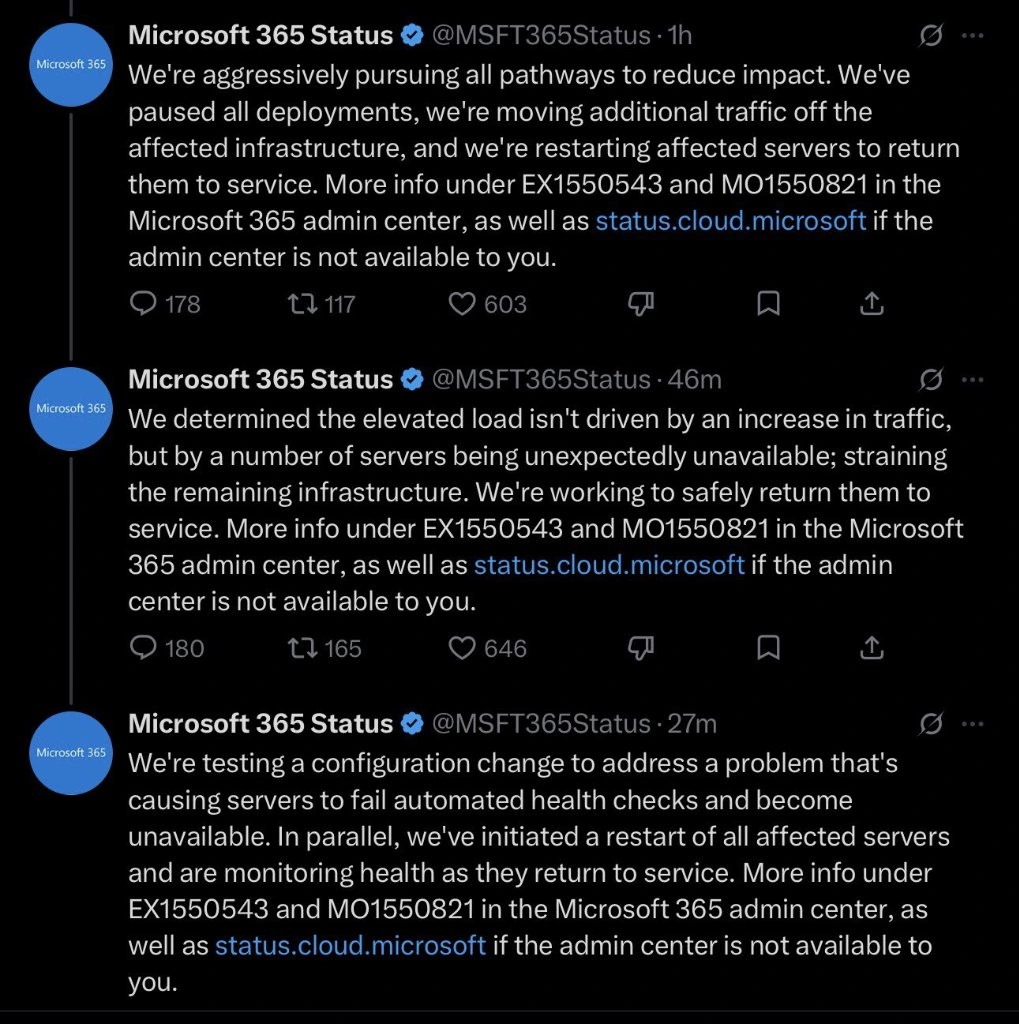
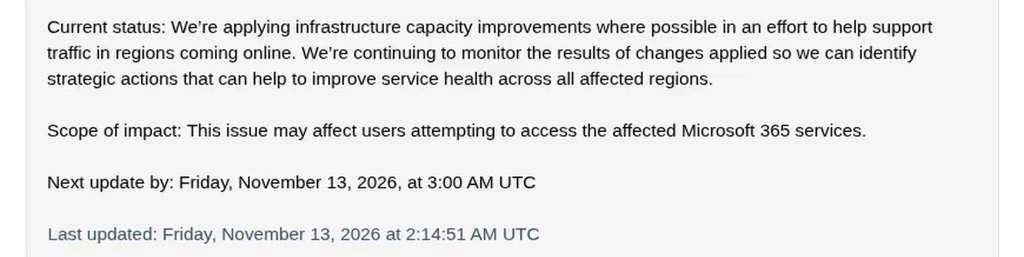
- Global Service Paralysis: Tracked officially under incident IDs EX1550543 (Exchange Online) and MO1550821 (Microsoft 365 suite), the outage expanded from initial mailbox access failures in the Americas into a worldwide connectivity breakdown.
- Internal Health Check Failures: Microsoft confirmed the disruption is not caused by an external traffic surge or DDoS attack. Instead, a large fleet of backend servers became unexpectedly unavailable after failing automated health checks, shifting catastrophic load onto the surviving infrastructure.
- Recovery Stalls and Crash Loops: Isolated servers restarted by engineering teams initially showed stability, but immediately became unresponsive again as soon as live customer traffic was reintroduced.
- Internal Communication Breakdown: In an ironic twist highlighting the severity of the Exchange Online failure, Microsoft reportedly attempted to email its top engineers about the outage, but staff were unable to receive the dispatch due to the crashed mail servers.

Microsoft 365 Global Outage: Incident Details and Impacted Services
| Incident Parameter | Status & Technical Scope |
|---|---|
| Official Incident Identifiers | EX1550543 (Exchange Online), MO1550821 (Microsoft 365 Suite) |
| Outage Duration | Over 10 hours ongoing (Began November 12, continuing November 13, 2026) |
| Primary Impacted Microsoft Services | Microsoft Outlook, Exchange Online, Microsoft Teams, SharePoint, OneDrive, Microsoft Copilot, Defender XDR, Microsoft Store, Microsoft Account |
| Infrastructure Services Affected | Microsoft Azure, Microsoft Entra ID (Azure AD), Microsoft Dynamics 365 |
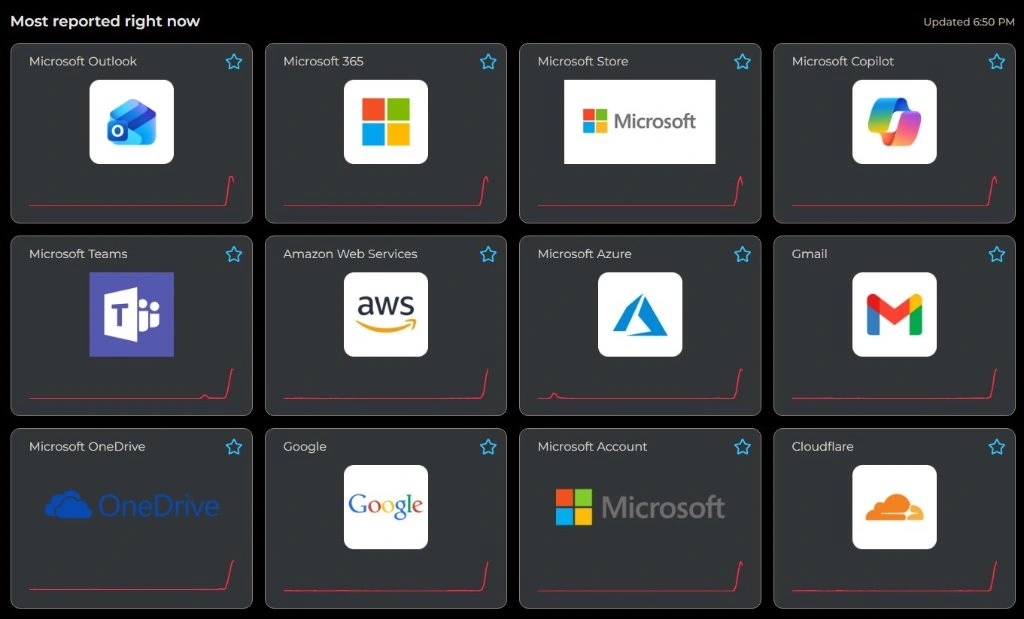
| Collateral SaaS Platforms Disrupted | Slack, Zoom, Salesforce, Claude AI, Amazon Web Services (SSO and authentication dependency spikes on Downdetector) |
| Identified Failure Mechanism | Core server process overwhelmed; cascading failure of automated health checks causing severe capacity loss |
| Mitigation Workstreams Deployed | Deployment freezes, configuration rollbacks, isolated server rebuilds, selective traffic filtering, global rerouting |
| Public Incident Telemetry | status.cloud.microsoft and Microsoft 365 Admin Center |

Recovery Failures: Why Restored Servers Keep Crashing
Microsoft status updates published to the official Microsoft 365 Status channel reveal that engineering teams are caught in a difficult recovery cycle. A core process running on host servers is becoming overwhelmed, resulting in immediate capacity loss. While technicians successfully restored a portion of affected servers in an isolated state, those machines rapidly locked up and became unresponsive the moment real-world traffic pathways reopened.

To combat the recurring crashes, Microsoft has frozen all software deployments across its cloud estate and initiated configuration rollbacks to test whether older software builds prevent nodes from failing automated health checks. In parallel, engineers are temporarily throttling and filtering incoming traffic in specific geographical regions to protect recovering nodes. This operational crisis follows recent system updates across the broader ecosystem, including the Windows 11 November 2026 update rollout, which also introduced cloud-linked recovery mechanisms.
The Cascading Ripple Effect: Airlines, AI Connectors, and Enterprise SSO Disruption
Because modern enterprise software relies heavily on Microsoft Azure and Microsoft Entra ID (formerly Azure Active Directory) for authentication and backend communication pipelines, the core server failures have unleashed severe secondary disruptions across unrelated industries:
| Impacted Platform / Entity | Industry Sector | Reported Failure & Operational Impact |
|---|---|---|
| Virgin Atlantic | Aviation / Travel | Passenger one-time password (OTP) delivery failure since midnight; web check-in and booking verifications stalled. |
| IndiGo Airlines | Aviation / Travel | Widespread customer OTP delivery failures affecting flight status tracking, digital passenger check-ins, and booking portals. |
| OpenAI ChatGPT (Enterprise) | Artificial Intelligence | Microsoft 365 data connectors completely severed; enterprise workspaces unable to index SharePoint documents or query Outlook calendars. |
| Anthropic Claude | Artificial Intelligence | Enterprise M365 integrations returning continuous authentication timeout errors during federated document retrieval. |
| Autodesk | Engineering & Design | Engineers and architects locked out of cloud CAD suites; secondary multi-factor authentication (MFA) and OTP codes failing to arrive. |
| Workhorse Group | Automotive / Public Corp | Official postponement of Q3 2026 quarterly financial results and earnings call due to catastrophic internal system disruption. |
| Okta & Enterprise SSO | Identity Security | Federated authentication handshakes timing out for thousands of corporate tools linked to Microsoft Entra user directories. |
| Corporate Windows Laptops | Enterprise IT | Remote employees unable to log into domain-joined Windows laptops as local cached credential handshakes fail against unreachable cloud domain controllers. |
In the aviation sector, both Virgin Atlantic and India’s largest carrier, IndiGo, experienced acute customer-facing bottlenecks. Passengers attempting to log in, manage bookings, or access digital boarding passes reported that mandatory verification OTPs failed to arrive for hours. These communication pipelines depend on Azure-backed communication relays and Exchange Online SMTP gateways, meaning that a server failure in Redmond directly disrupted airport operations across Europe and Asia.
The outage has also struck generative artificial intelligence workflows. Thousands of enterprises relying on ChatGPT Enterprise and Anthropic Claude reported that internal Microsoft 365 connectors stopped functioning. Because the underlying Microsoft Graph APIs are unresponsive, corporate AI models are currently unable to access SharePoint knowledge bases, summarize email threads, or pull internal spreadsheets.
Corporate reporting has felt the financial sting as well. Electric vehicle manufacturer Workhorse Group took the extraordinary step of formally postponing its scheduled third-quarter 2026 earnings release, explicitly citing widespread operational disruption caused by the Microsoft infrastructure outage. Meanwhile, IT helpdesks worldwide are swamped as remote employees find themselves completely locked out of corporate Windows laptops when local login daemons attempt to authenticate against unreachable cloud domain controllers.
Enterprise Disruption and Cascading Third-Party Failures
Beyond airlines and AI connectors, Downdetector recorded massive spikes in disruption reports for enterprise staples including Slack, Zoom, and Salesforce. These failures stem from federated identity bottlenecks: because Microsoft Entra ID and Microsoft Account services are failing to authenticate requests, corporate employees remain locked out of third-party tools that rely on Microsoft single sign-on (SSO).

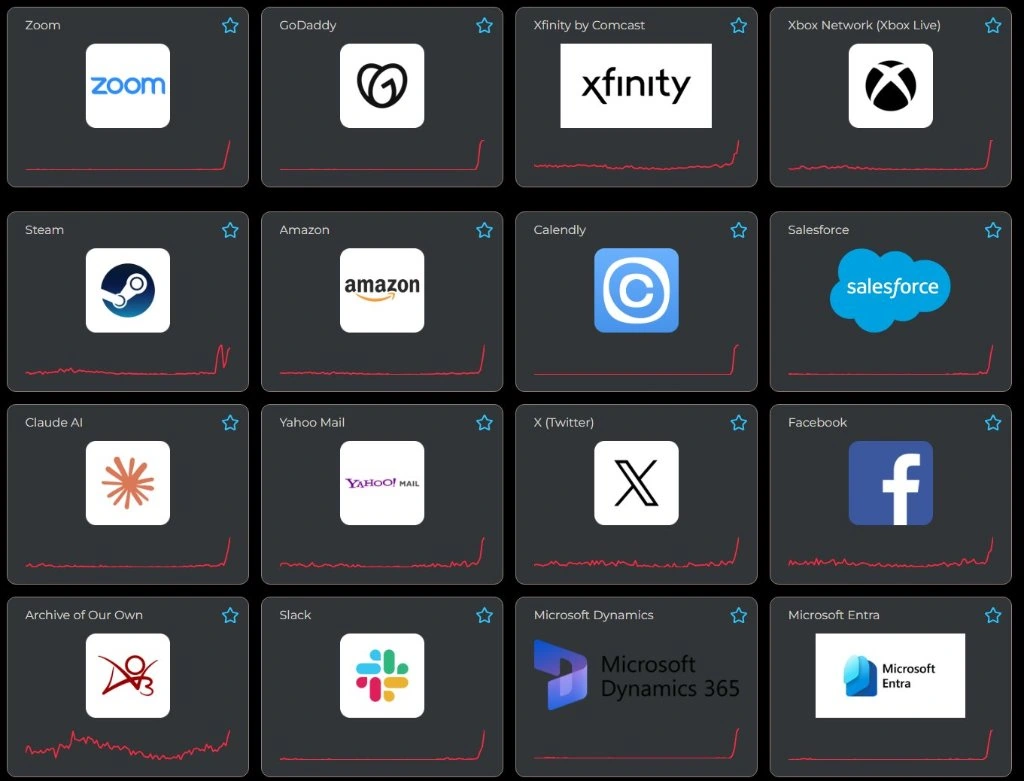
The widespread disruption mirrors previous multi-tenant cloud bottlenecks, such as the Cloudflare outage that impacted AI platforms earlier this month. With Outlook web access returning HTTP 503 errors and Teams failing to synchronize messages, enterprise operations across finance, healthcare, and software development remain severely hindered as Microsoft works toward an all-clear.
PFD Context
This incident demonstrates the inherent fragility of modern cloud concentration, where millions of organizations depend on a single centralized authentication and productivity pipeline. As observed during previous global cloud infrastructure crashes, when identity federation engines like Microsoft Entra buckle, the failure radius extends far beyond email into mission-critical SaaS tools. The inability of restored servers to handle incoming production load highlights an acute thundering-herd problem that Microsoft must resolve architecturally before full stability can be guaranteed.