
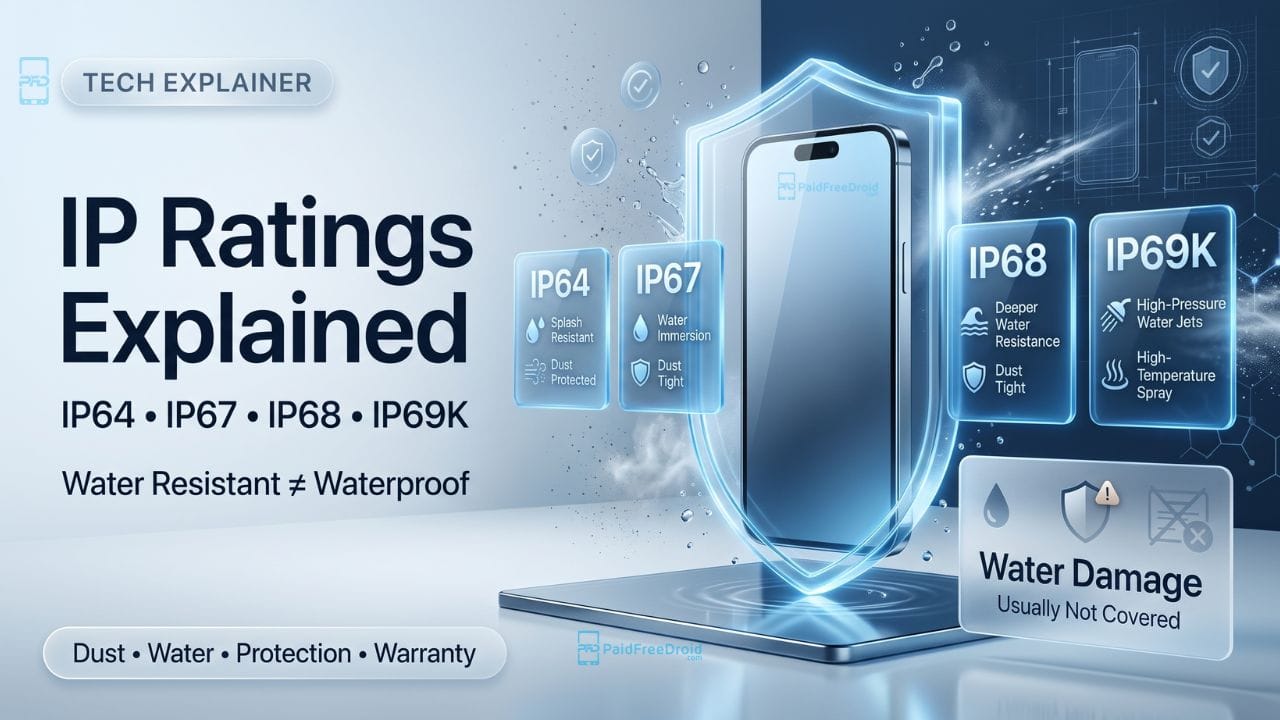
Whether you are shopping for a mid-range budget phone or a top-tier ultra flagship, “water and dust resistance” has become one of the most heavily advertised features on spec sheets. Today, smartphone makers throw around codes like IP64, IP68, and even industrial-grade IP69K to prove how tough their devices are.
However, for most everyday consumers, these alphanumeric codes can feel like confusing alphabet soup. Does an IP68 phone let you go scuba diving? Why do some rugged phones advertise dual ratings like IP68 + IP69? And most importantly – if your phone is officially certified as “water-resistant,” why will the service center reject your warranty claim the second it gets wet?
Here is your complete PFD guide to decoding Ingress Protection (IP) ratings, what each number actually guarantees, and the harsh reality behind smartphone liquid warranties.
What Does “IP” Actually Stand For?
IP stands for Ingress Protection (or International Protection code). Developed under international standard IEC 60529, an IP rating classifies exactly how well an electrical enclosure (like your smartphone chassis) blocks external foreign bodies from entering the device.

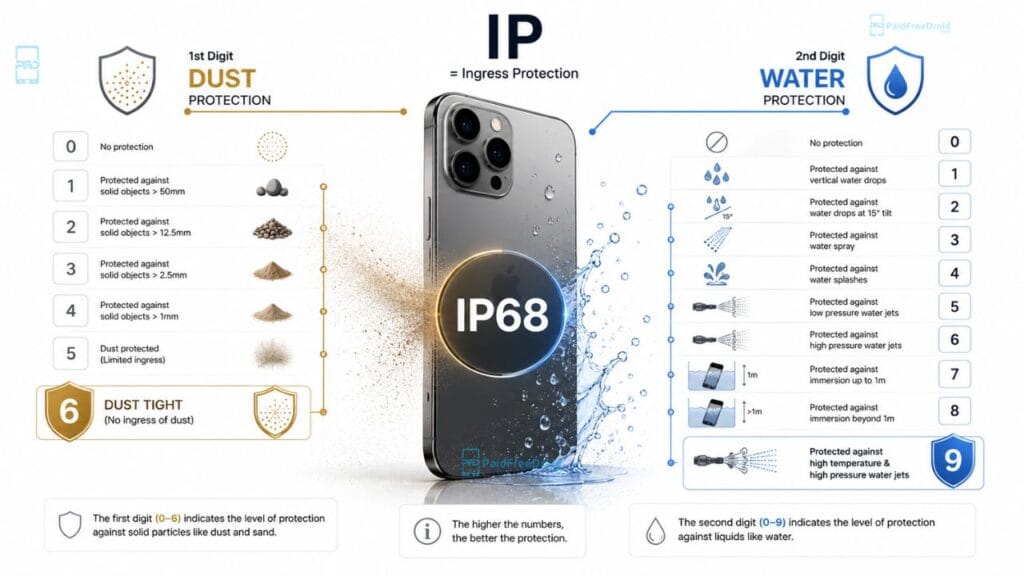
Every standard IP rating is composed of the letters “IP” followed by two individual numbers:
- First Number (Solid & Dust Protection): This digit ranges from 0 to 6 and grades the device’s protection against solid objects like dust, sand, and dirt. Currently, 6 is the maximum possible score, meaning the device is completely “dust-tight” with zero particle ingress.
- Second Number (Liquid & Water Protection): This digit ranges from 0 to 9 (or 9K in industrial testing) and indicates how well the device resists moisture and water. A higher number generally represents superior protection against heavier water volume, depth, or pressure.
- What Does an “X” Mean? If you see a rating like IP6X or IPX8, the “X” simply means the device was not tested or rated for that specific category. For example:
- IP6X: Complete dust protection, but no rated water resistance.
- IPX8: No official dust protection rating, but tested for deep water immersion.
Master IP Rating Decoder: From Splashes to High-Pressure Steam
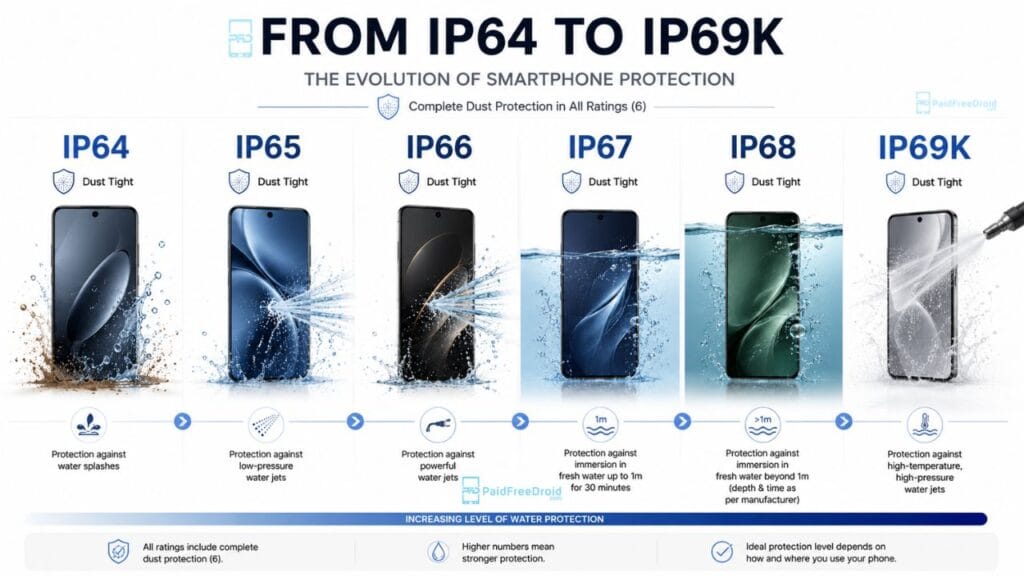
To help you understand what your device can actually survive in the real world, here is the official breakdown of the most common smartphone and electronics IP ratings:
| IP Code | Dust Protection Level | Liquid & Water Protection Level | Real-World Survival Scenario |
| IP64 | Complete Dust Protection | Protection against water splashes from any direction. | Caught in light rain or accidentally splashing tap water on your desk. |
| IP65 | Complete Dust Protection | Protection against low-pressure water jets (6.3mm nozzle). | Washing your phone under a gentle running tap or surviving heavy rainstorms. |
| IP66 | Complete Dust Protection | Protection against high-pressure water jets from any direction. | Surviving powerful spray hoses or dropping it on a wet boat deck. |
| IP67 | Complete Dust Protection | Protection against immersion into fresh water up to a depth of 1 meter for up to 30 minutes. | Accidentally dropping your phone into the toilet, sink, or a shallow swimming pool. |
| IP68 | Complete Dust Protection | Protection against immersion into fresh water at a depth of at least 1.5 meters for 30 minutes. | Extended underwater photo sessions in shallow freshwater pools or surviving deep puddles. |
| IP69 | Complete Dust Protection | Protection against high-pressure (~100 bar) and high-temperature (~80°C) water jets. | Enduring extreme industrial washdowns, hot shower jets, or heavy outdoor field abuse. |
| IP69K | Complete Dust Protection | Protection against high-pressure (~100 bar) and high-temperature (~80°C to 100°C) water jets from multiple angles. | Surviving direct industrial steam cleaning and high-angle pressure washing. |
Important Nuances: Why IP68 and IP69 Are Different Behemoths
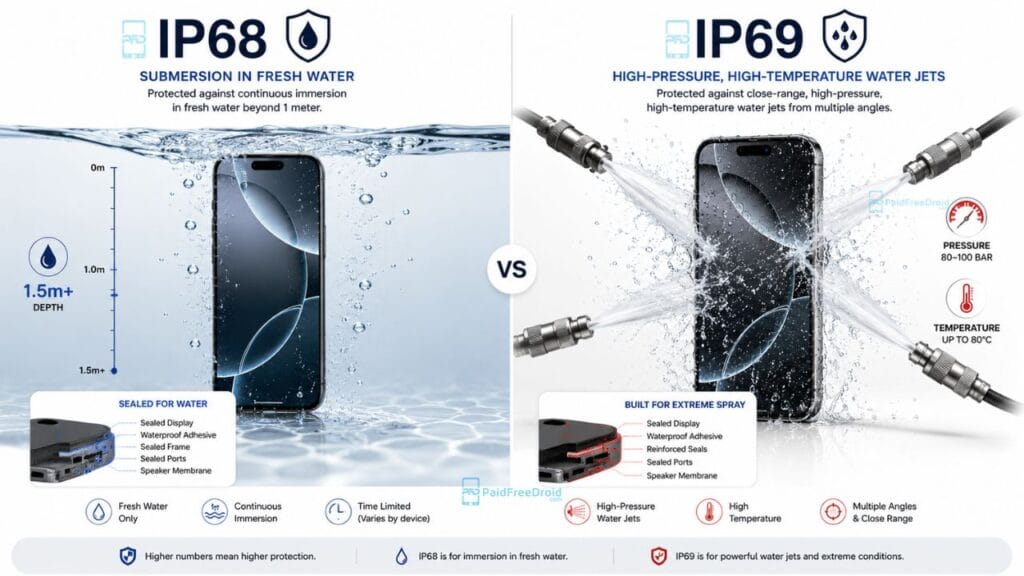
While looking at the chart above makes it seem like IP69 is simply a direct upgrade over IP68, they actually test completely different physical failure points:
1. “Manufacturer Rule” of IP68
Unlike IP67 (which is strictly locked at 1 meter for 30 minutes), IP68 does not have a single fixed depth limit. The International Electrotechnical Commission mandates that IP68 must be at least 1.5 meters for 30 minutes, but the exact depth and duration are ultimately defined by the manufacturer.
- For example, Samsung typically certifies its flagships at 1.5 meters for 30 minutes, while Apple certifies recent iPhone Pro models to withstand submersion up to 6 meters for 30 minutes. Both share the “IP68” label, but their actual survival thresholds differ dramatically.
2. Why Some Phones Advertise Dual Ratings (e.g., IP68 + IP69)
You might assume that an IP69-rated phone is automatically safe underwater, but IP69 only tests for high-pressure, hot water jets – it does not guarantee resistance against prolonged underwater submersion. A phone with only an IP69 rating could actually fail a basic swimming pool dive! This is why ultra-durable devices now proudly boast a dual IP68 + IP69 badge, certifying that they can handle both deep underwater immersion and high-pressure water spray.
Brutal Truth: Why No Brand Covers Water Damage Under Warranty
Here is the most important rule in tech journalism that every smartphone owner must memorize:
⚠️ No brand provides warranty coverage if your phone or any other electronic product is damaged by water.
It does not matter if you paid ₹1,50,000 for a flagship with IP68, IP69, and military-grade certifications. If you open your SIM tray and the internal Liquid Damage Indicator (LDI) sticker has turned pink or red from moisture, your manufacturer warranty is immediately voided.
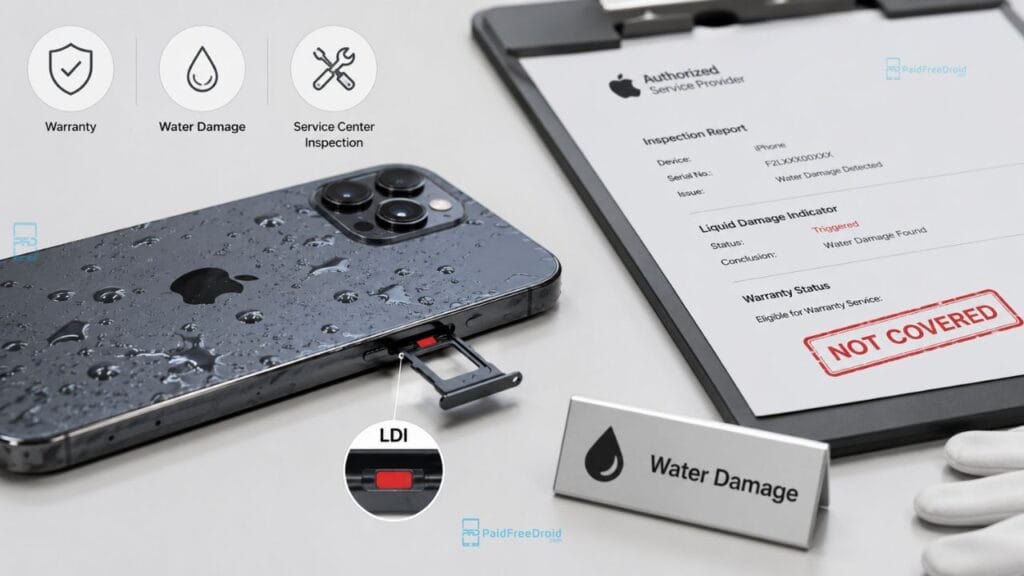
Why do companies advertise water resistance if they won’t stand behind it?
- Lab Conditions vs. Real World: IP testing is conducted inside strictly controlled laboratory chambers using static, clean freshwater. Real-world water contains chlorine (swimming pools), salt and minerals (seawater), or soaps and chemicals (showers/sinks). Salt and chlorine aggressively corrode internal PCBs and dissolve protective rubber seals.
- Seals Degrade Over Time: Smartphone waterproofing relies on microscopic rubber O-rings, silicone seals, and water-repellent adhesives. Over months of daily use, normal device heat cycles, UV exposure, and accidental physical drops cause these seals to weaken, crack, and shift. A phone that easily survived a pool plunge on day one might leak like a sieve two years later.
PFD Verdict: Treat IP Ratings as Insurance, Not an Invitation
An Ingress Protection rating is an incredible engineering achievement meant to act as a safety net for accidents, not an open invitation to shoot underwater TikTok videos in the ocean.
When buying your next smartphone, look for an IP67 or IP68 rating for genuine peace of mind against everyday rain storms, toilet drops, and spilled coffee. If you work in construction, industrial manufacturing, or field logistics, seek out rugged devices carrying IP69 or IP69K for protection against high-pressure hose cleanings.
Just remember: always dry your phone thoroughly with a soft cloth after an accidental splash, never charge it while the charging port is wet, and keep it out of the ocean at all costs.
Tags: IP ratings explained, IP64 vs IP68, IP68 vs IP69K, smartphone water resistance, Ingress Protection codes, liquid damage warranty India, tech explained


