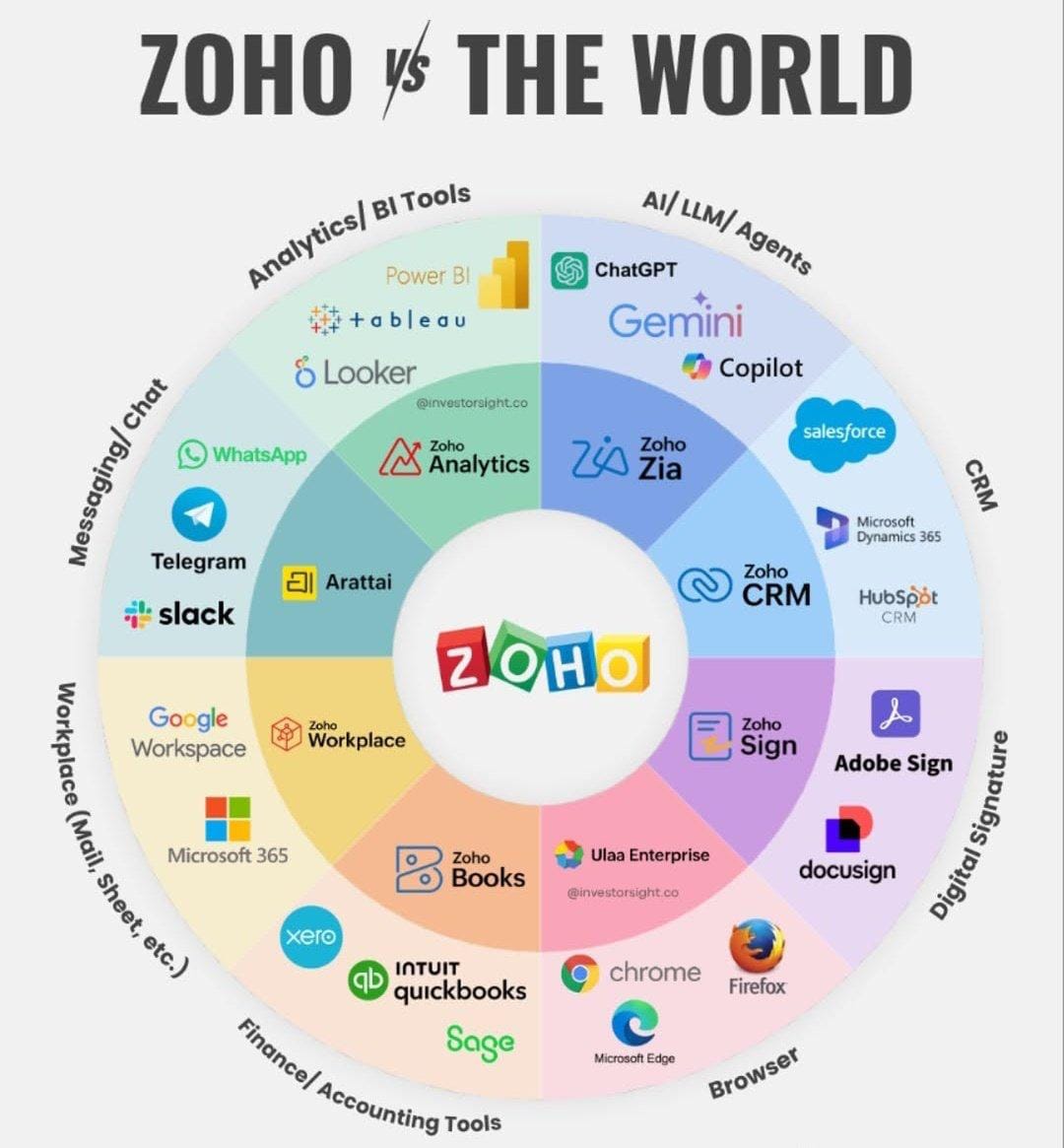
In a striking infographic titled “Zoho vs The World,” Zoho positions its suite of products head-to-head against global leaders in analytics, AI, CRM, messaging, finance, and productivity. As Zoho aggressively builds its in-house AI stack and expands adoption, the comparison underscores its ambition to rival established tech giants.

Mapping Zoho’s Product Comparisons
Zoho’s visual of competition lines up its offerings against prominent alternatives in various categories. The key pairings include:
- Analytics/BI tools: Zoho Analytics vs Power BI, Tableau, Looker
- AI/LLM/Agents: Zoho Zia vs ChatGPT, Gemini, Copilot
- CRM: Zoho CRM vs Salesforce, Microsoft Dynamics 365, HubSpot
- Digital signature: Zoho Sign vs Adobe Sign, DocuSign
- Finance/Accounting: Zoho Books vs QuickBooks, Sage, Xero
- Messaging/Chat: Zoho’s Arattai vs WhatsApp, Telegram, Slack
- Workspace/Productivity: Zoho Workplace vs Google Workspace, Microsoft 365
- Browser /Client tools: Zoho’s Ulaa browser vs Chrome, Firefox, Edge
This layout aims to communicate that Zoho is building cross-category alternatives rather than just point products.
Zoho’s AI Push: Zia LLM and Agent Suite
Building Its Own AI Foundation
In July 2025, Zoho announced Zia LLM, a proprietary large language model (LLM) suite (with 1.3B, 2.6B, and 7B parameter variants). Zoho emphasised data privacy, hosting the models across its own data centres in India, the U.S., and Europe.
It also launched automatic speech recognition (ASR) models for English and Hindi, with plans to expand to more languages.
Agent Studio, Agent Marketplace & MCP
Zoho introduced Zia Agent Studio, a no-code interface enabling users to design agents that perform actions across Zoho’s product suite.
Over 25–40 prebuilt Zia Agents (depending on report) are available to start immediately, covering sales, support, workflows, and analytics tasks.
Zoho also introduced a Model Context Protocol (MCP) server, enabling cross-application workflows and integration with third-party agents.
Together, this AI stack is intended to differentiate Zoho not just as a suite of apps, but as a platform with embedded intelligence.
Growing Adoption & Government Backing in India
Rising Usage & Institutional Support
Zoho’s products have seen increased traction, especially in India, amid a broader push for indigenous alternatives to global tech. Its messaging app, Arattai, surged in usage by 100 times in September 2025, registering over 350,000 daily sign-ups.
Simultaneously, the Indian government has promoted Zoho and its ecosystem as reliable “Swadeshi” tech options, encouraging its use within ministries and public sector units.
Strategic Setback: Chipmaking Ambitions Paused
Zoho’s $700 million plan to enter chip manufacturing was suspended in May 2025 due to lack of a strong technology partner, marking a notable pivot. This move underscores that software remains Zoho’s core strength and focus.
Comparing Strengths, Risks & Competitive Dynamics
Strengths in Zoho’s Favour
- Integrated stack: Zoho’s “all-in-one” approach lets users stay within a unified ecosystem, reducing friction between apps.
- Cost advantage: Often priced lower than mainstream options, Zoho appeals to small and medium enterprises (SMEs) and budget-conscious users.
- Data control & privacy: In-house AI and control of infrastructure allow greater assurance of data residency and governance.
- National narrative: Government endorsements give Zoho a narrative edge in India for tech sovereignty and reduced reliance on foreign platforms.
Challenges & Risks
- Scale & maturity: Global competitors like Microsoft, Google, and Salesforce have decades of enterprise trust, massive R&D budgets, and entrenched relationships.
- Feature gaps: While Zoho is rapidly adding AI capability, matching depth, performance, customisation, and global enterprise features is a long journey.
- International perception: To compete globally, Zoho must overcome perceptions of being India-centric or limited in reach.
- Infrastructure & reliability: Scaling AI, messaging, and global operations demands sustained investments in data centres, reliability, and compliance.
What This Means for Users & Businesses
- Greater choice: Organisations evaluating CRM, analytics, or productivity tools now have an emerging alternative that tries to consolidate multiple domains.
- Better alignment with Indian policies: Entities subject to data localisation or “Make in India” mandates may find Zoho more compliant or palatable.
- AI-enabled workflows: With embedded agents and automation, users may achieve efficiencies without integrating disparate third-party tools.
- Risk hedging: Businesses heavily tied to one major vendor may see Zoho as a diversification path.
The Zoho vs The World infographic is more than marketing — it reflects Zoho’s strategic positioning as a full-stack challenger to global tech giants. By investing heavily in its own AI infrastructure, pushing for government adoption, and offering competitive alternatives in CRM, analytics, messaging, and productivity, Zoho is aiming to redefine how businesses view enterprise software. Its success will depend on scaling globally, closing gaps in feature depth, and proving reliability at large scale.
Tags: Zoho vs world, Zoho ecosystem, Zoho Zia, Zoho AI agents, Zoho vs Microsoft, Zoho CRM, Zoho analytics, Zoho Arattai, Indian tech sovereignty, Zoho AI strategy