Reliance Jio has begun strictly suspending incoming voice calls and incoming SMS services for prepaid subscribers shortly after their recharge plans expire, while dispatching high-urgency text messages warning of permanent number disconnection. The move directly threatens millions of Indian mobile subscribers who maintain secondary Jio SIM cards exclusively for banking one-time passwords (OTPs), UPI transactions, and identity verification, triggering widespread debate regarding regulatory protections under Telecom Regulatory Authority of India (TRAI) guidelines.
Key Highlights: Jio Inactive SIM Warning Notices
The tightening of inactive SIM enforcement brings critical operational and regulatory changes for Jio prepaid subscribers:
- Incoming Calls and SMS Barred: Subscribers without an active paid recharge are experiencing prompt incoming call and SMS suspensions, cutting off essential banking OTP deliveries.
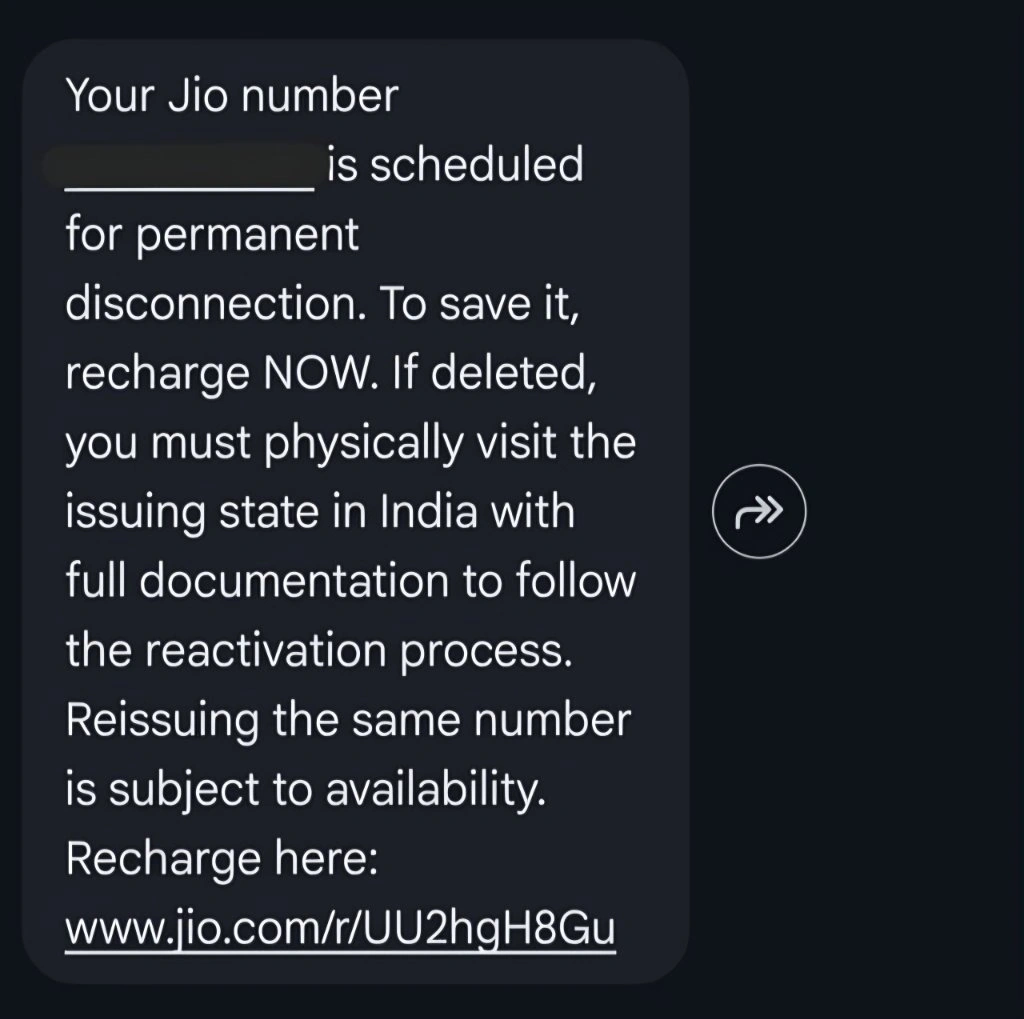
- Permanent Disconnection Warnings: Jio automated alerts inform users that their mobile numbers are scheduled for permanent disconnection unless a fresh recharge is completed immediately.
- Physical Home-State Visit Mandate: The warning explicitly warns that if a number is deleted, the subscriber must physically travel to the original SIM-issuing state with full physical documentation to attempt reactivation, subject to number availability.
- TRAI 90-Day Protection vs Service Suspension: While TRAI regulations strictly prohibit permanent SIM deactivation within 90 days of non-usage, telecom operators legally exploit service validity gaps to halt incoming network traffic.

Jio Inactive Disconnection Warnings vs TRAI 90-Day Regulations
Understanding the vital distinction between carrier service suspension and statutory regulatory deactivation is crucial for every mobile user:
| Regulatory Stage | Jio Enforcement Practice | TRAI Regulatory Mandate (TCPR) | Consumer Impact & Rights |
|---|---|---|---|
| Plan Expiry (Days 1 to 14) | Outgoing calls stop immediately; incoming calls and incoming SMS barred shortly after | No specific mandate forcing free incoming routing without an active tariff plan | Banking OTPs, UPI verification, and incoming calls fail; immediate recharge demanded |
| Inactive Warning Window (Days 15 to 60) | Automated SMS alerts threaten scheduled permanent disconnection and physical state visit | Connection cannot be permanently closed or surrendered if under 90 days of non-usage | Creates artificial urgency; number remains legally assigned to the subscriber |
| 90-Day Non-Usage Threshold | Service remains fully suspended; number flagged for deactivation and recycling pool | Telcos cannot deactivate prepaid SIMs for non-usage for a minimum period of 90 days | Incoming voice calls count as usage under TRAI rules and reset the 90-day timer |
| Automatic Number Retention | Requires active plan purchase to restore network validity and incoming routes | If account balance exceeds ₹20, telco can deduct up to ₹20 to extend validity by 30 days | Subscribers with unused main balance can prevent deactivation without full monthly bundles |
| Permanent Deactivation & Grace Period | Number surrendered; requires physical visit to issuing circle with identity proof | Mandatory 15-day notice/grace period required before final deactivation and number re-allotment | Once recycled by the telco, the original user permanently loses all linked digital accounts |
Secondary SIM Dilemma: Banking OTPs, UPI Apps, and Cross-State Hurdles
For years, Reliance Jio served as the preferred secondary SIM choice for Indian consumers. Unlike Bharti Airtel and Vodafone Idea, which instituted strict 7-day to 14-day incoming validity cutoffs years ago to force recurring recharges, Jio historically allowed incoming calls and incoming SMS to remain active for extended periods without continuous top-ups. As a result, millions of smartphone owners registered their Jio numbers with bank accounts, Aadhaar authentication, mutual fund folios, and Unified Payments Interface (UPI) platforms like Google Pay, PhonePe, and Paytm.
The aggressive suspension of incoming SMS strikes directly at this usage pattern. Without incoming SMS, subscribers cannot receive two-factor authentication codes for online net banking or debit card approvals. Furthermore, modern UPI applications require background outbound SMS handshakes to re-authenticate bank accounts during device or SIM swaps, rendering digital payments completely inaccessible if the secondary number lacks active plan validity. Subscribers reviewing active Jio recharge plans and promotional offers must now factor in a continuous monthly expenditure just to keep secondary numbers functional.
Adding to consumer anxiety is Jio’s explicit warning that recovering a permanently disconnected number requires physically visiting the original SIM-issuing state with full identity documentation. For India’s massive population of interstate migrant workers, corporate professionals, and university students residing outside their home telecom circles, travelling across states to reclaim a disconnected SIM is practically impossible. While alternative operators expand inter-circle roaming and network pacts, crossing state lines for manual re-KYC paperwork highlights the severe operational friction facing dormant subscribers.
To maintain secondary SIM validity on Jio without buying expensive daily data plans, the most cost-effective option remains the ₹189 Value Plan, which delivers 28 days of service validity, 2GB of total data, 300 SMS, and unlimited voice calls. For longer coverage, subscribers can opt for the ₹479 pack (84 days validity, 6GB data, 1,000 SMS) or the ₹1,899 annual pack (336 days validity, 24GB data, 3,600 SMS), which provides near year-round peace of mind against sudden incoming cutoffs.
PFD Context
Jio’s aggressive inactive subscriber notices mark the final burial of India’s free incoming calling era. As major private telecom operators push average revenue per user (ARPU) toward ₹200 and beyond ahead of anticipated public listings, following telecom ARPU expansion trends across Indian carriers, non-paying secondary SIMs have transformed from subscriber-acquisition assets into network liabilities. By exploiting the regulatory gap between service suspension and TRAI’s 90-day deactivation ban, carriers have effectively established a mandatory subscription fee for maintaining access to one’s own digital identity.