Memory components now account for an astonishing 54% of the total Bill of Materials (BoM) in entry-level smartphones, surging nearly three-fold from just 20% in the third quarter of 2025, according to newly published data from Counterpoint Research. The unprecedented supply crunch and pricing surge in mobile DRAM and NAND flash are severely compressing hardware margins across budget handsets, threatening consumer affordability and signaling extended retail price inflation through 2027.
Key Highlights: Memory Takes Over Budget Phone Costs
Key findings from Counterpoint Research highlight the severity of the ongoing semiconductor shift:
- Memory Triples in BoM: Memory’s share of total component costs in entry-level smartphones jumped from 20% in Q3 2025 to 54% in Q3 2026, representing a massive 2.7x expansion in a single year.
- DRAM Surpasses the Application Processor: In a historic structural reversal, DRAM has overtaken the mobile system-on-chip (SoC) as the single most expensive physical component in affordable smartphones.
- AI Datacenter Demand Cannibalizes Mobile Fabs: Leading semiconductor memory fabricators continue reallocating silicon wafer capacity toward high-margin High Bandwidth Memory (HBM3E and HBM4) and server DDR5, starving consumer mobile lines of legacy LPDDR4X and LPDDR5 supplies.
- Continued Pricing Pressure Through 2027: Analysts warn that with memory suppliers prioritizing high-margin AI infrastructure clients, the shortage of cost-effective mobile DRAM will keep handset retail prices elevated well into 2027.

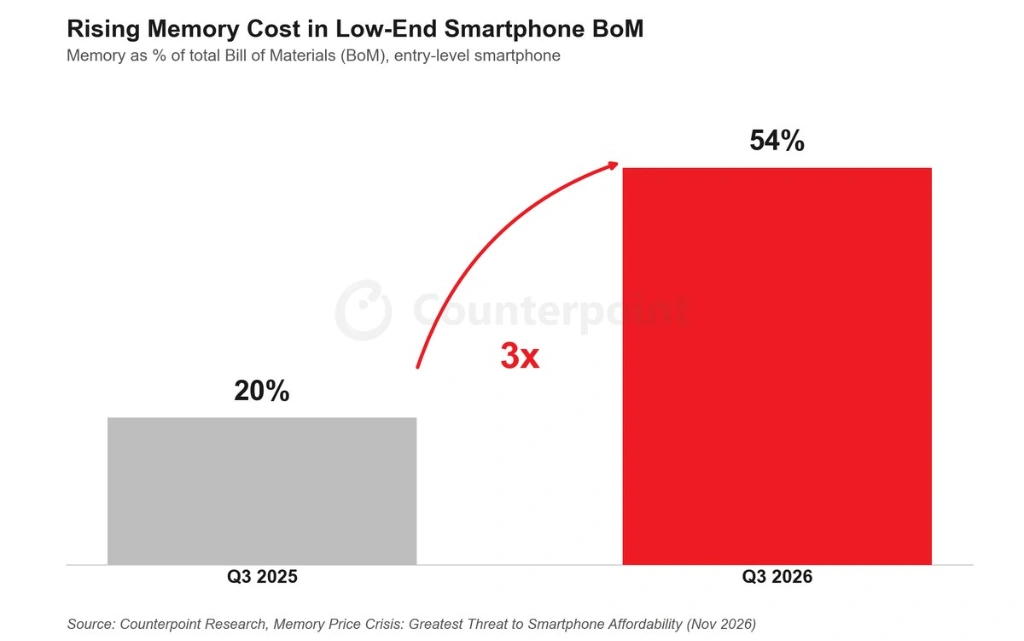
Low-End Smartphone Bill of Materials (BoM): Q3 2025 vs Q3 2026 Cost Shifts
The reallocation of global wafer allocation toward AI infrastructure has radically altered component share dynamics for budget mobile hardware:
| Component Category | Q3 2025 BoM Share | Q3 2026 BoM Share | Net Shift | Primary Cost Driver |
|---|---|---|---|---|
| Memory (DRAM + NAND Flash) | 20% | 54% | +34% (2.7x surge) | Severe mobile fab capacity crunch; AI server HBM prioritization |
| Application Processor (SoC) | 28% | 19% | -9% (share squeeze) | Cost compressed as memory absorbed bulk of production budget |
| Display Panel (LCD / Rigid OLED) | 18% | 11% | -7% | Mature display supply lines maintained stable pricing |
| Camera Modules | 14% | 7% | -7% | Sensor downgrades and cost trimming by budget OEMs |
| Battery & Power ICs | 10% | 5% | -5% | Stable cell pack pricing offset by tighter margin allocation |
| Enclosure, RF, & Passive Components | 10% | 4% | -6% | Aggressive bill trimming across secondary hardware brackets |
Why Cheap Phones Are Bearing the Brunt of Global Memory Reallocation
The global memory price crisis, commonly dubbed RAMageddon by semiconductor industry observers, is exerting a disproportionate toll on budget handset manufacturers. While premium flagships priced above $800 retain enough gross profit margin to absorb component price spikes, entry-level devices operating on razor-thin single-digit margins have no financial buffer. When memory costs explode from one-fifth to more than half of the total component expenditure, device makers face an uncompromising binary choice: raise retail prices immediately or execute drastic hardware compromises.
This structural crisis explains the sharp wave of retail price hikes across the Indian smartphone landscape this month. PaidFreeDroid recently tracked major pricing revisions, including the Redmi smartphone price hike across 15 models, which saw budget handsets like the Redmi A7 and Redmi 15A climb by up to ₹3,000. Similarly, the POCO smartphone price hike across M and C series added up to ₹3,000 to entry-level 5G and 4G handsets, while the Vivo smartphone price hike on V80, S2, and Y11 added up to ₹5,000 across tiers. The pressures have even spilled over to personal computing, driving steep tablet price increases on Samsung Galaxy Tab A11+ and OnePlus Pad 4 by up to ₹23,000.
To survive without hiking retail prices past psychological price barriers, some original equipment manufacturers (OEMs) have begun trimming secondary specifications, eliminating bundled wall chargers, downsizing camera sensors, or even sourcing recycled reballed memory modules for ultra-budget 4G handsets. However, with consumer demand in price-sensitive emerging markets leaning firmly toward 5G connectivity and higher multitasking requirements, baseline RAM quotas cannot be reduced below 4GB or 6GB without crippling software performance.
PFD Context
The memory crisis is not a transient supply blip; it is an architectural reality created by the artificial intelligence boom. Silicon fabrication giants like Samsung Electronics, SK Hynix, and Micron are prioritizing high-bandwidth memory for AI hyperscalers where margins exceed 60%, deliberately constraining legacy consumer LPDDR silicon output. For Indian consumers, this structural squeeze signals the gradual extinction of the true sub-₹10,000 performance smartphone, forcing buyers to adjust budgets higher as the component bill continues inflating into 2027.