
Machine learning pioneer and Microsoft Research veteran John Langford has resigned from Microsoft following the formal dissolution of AI Frontiers, an internal exploratory research laboratory co-founded in 2023. In a detailed retrospective titled “The End of AI Frontiers” published on his academic blog hunch.net, Langford disclosed that an organizational reorganization in September 2026: which absorbed the approximately 50-person research collective into the commercial Microsoft AI division: triggered an irreconcilable philosophical divide between foundational algorithmic discovery and commercial brute-force model scaling.
Key Highlights of AI Frontiers Dissolution at Microsoft
- Foundational ML Pioneer Resigns: John Langford, co-founder of Microsoft Research New York City (2012), creator of Vowpal Wabbit, and former ICML president, formally exits Microsoft after more than a decade of research leadership.
- AI Frontiers Disbanded: Co-founded in 2023 in the immediate aftermath of ChatGPT to tackle artificial general intelligence through coordinated team science, the ~50-person sub-organization has officially shut down.
- Scaling vs. Science Conflict: Absorbed into the commercial Microsoft AI unit in September 2026, Langford and his team found their core research dismissed as “aggressively not research” under a product mandate committed strictly to brute-force scaling.
- Stranded Algorithmic Breakthroughs: Key efficiency and mathematical capabilities developed by the group: including the Next Latent extrapolation objective, the Dion3 optimizer, and recursive Full Bandwidth Transformers: were left without an internal deployment pathway.
- Exodus of Founding Leadership: Fellow senior research leaders within AI Frontiers reached identical conclusions regarding the erosion of exploratory freedom and joined Langford in departing the company.
Algorithmic Science vs Brute-Force Scaling: Methodological Divide
| Core Metric / Dimension | AI Frontiers (Foundational Research) | Commercial Microsoft AI (Model Scaling) |
|---|---|---|
| Guiding Hypothesis | Algorithmic innovation, efficient architectures, and structured mathematical extrapolation | Empirical scaling laws: increasing parameter counts, compute clusters, and dataset tokens |
| Core Architectures | Next Latent objectives, recursive Full Bandwidth Transformers, AutoGen agent coordination | Standard dense and mixture-of-experts (MoE) decoder-only transformer topologies |
| Optimization Strategy | Dion3 optimizer (refined Muon curvature algorithm) for rapid compute-efficient convergence | Standard AdamW variations distributed across massive multi-cluster GPU fabrics |
| Infrastructure Priority | Slashing training and inference compute costs through mathematical efficiency | Deploying multi-billion-dollar GPU clusters to capture incremental empirical gains |
| Organizational Alignment | Exploratory team science validating unconventional architectures against competitive baselines | Direct product feature integration targeting Copilot, Azure AI APIs, and enterprise tools |
| Deployment Path | Stranded: discarded internally as non-standard experimental methods | Direct production pipeline prioritizing fast commercial rollout |
Why AI Frontiers Was Formed After the Arrival of ChatGPT
The genesis of AI Frontiers dates back to 2023, during the tumultuous industry disruption that followed the public launch of OpenAI’s ChatGPT. Inside Microsoft Research (MSR), senior scientists realized that the traditional academic model: where individual, isolated researchers worked on distinct theoretical problems in small silos: had become structurally obsolete for frontier AI. Generating meaningful validation required access to vast compute fabrics, sophisticated data pipelines, and strong unified baseline models that no single scientist could operate alone.
To meet this operational challenge, John Langford: who previously co-founded Microsoft Research’s prestigious New York City laboratory in 2012 and created the renowned open-source machine learning platform Vowpal Wabbit: joined forces with colleagues to build AI Frontiers. The mission was straightforward: create an agile, 50-person research collective capable of executing synchronized, high-impact science. The group delivered early public successes, including the widely adopted AutoGen multi-agent orchestration framework and Fara, a pioneer in computer-use agents.
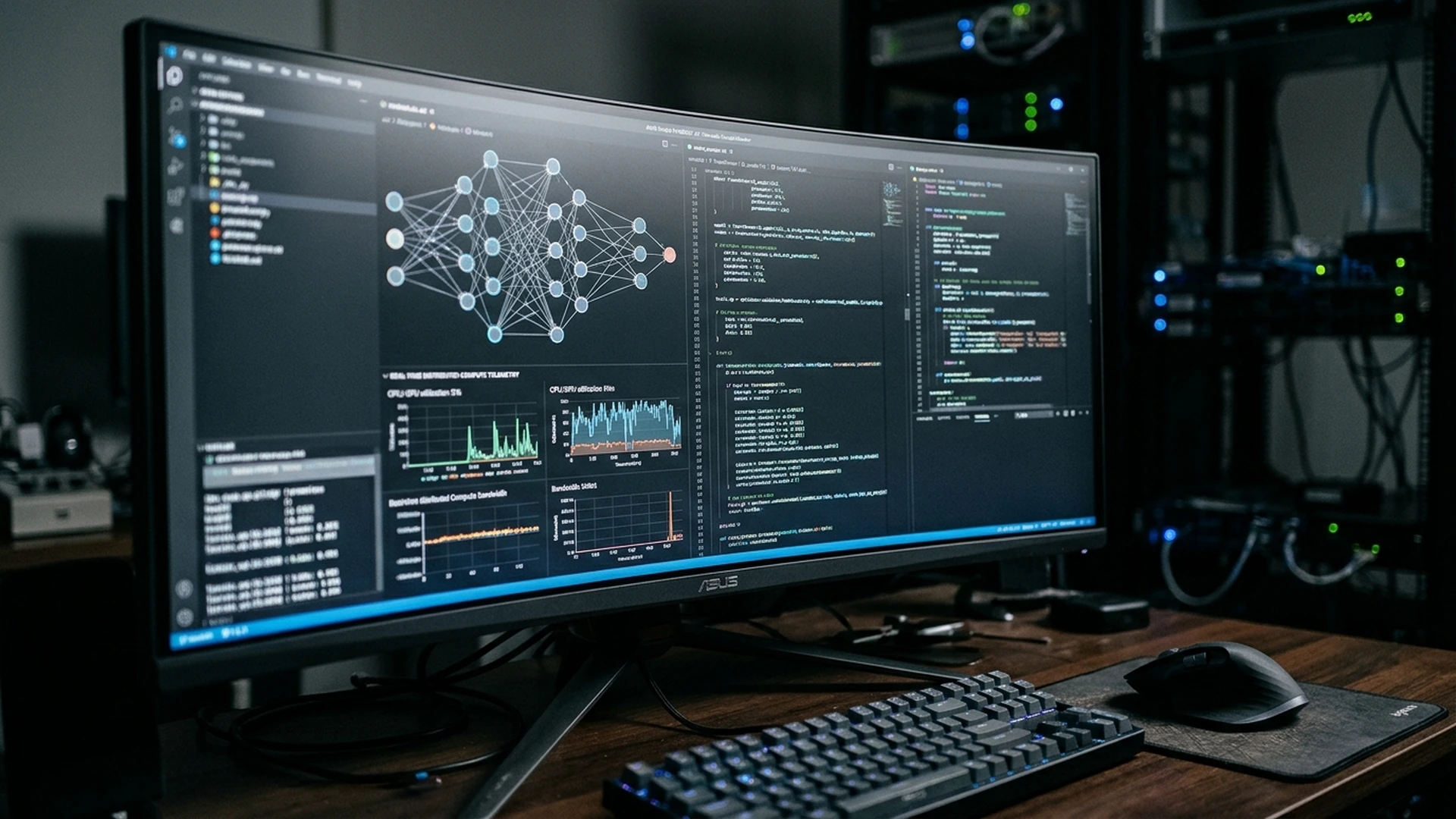
When Exploratory Research Collided with Microsoft AI Product Mandates
The structural equilibrium broke down in September 2026 when Microsoft reorganized its artificial intelligence units. Leadership transferred AI Frontiers out of the academic sanctuary of Microsoft Research and placed it directly within Microsoft AI (MAI), the commercial division established to run consumer and enterprise AI products under CEO Mustafa Suleyman and executives recruited from Inflection AI.
Inside the new organization, Langford and his researchers encountered an unyielding ideological wall. Microsoft AI operated under a singular engineering belief: that intelligence is purely an emergent property of empirical scale. Under this doctrine, progress is achieved by acquiring larger clusters of Nvidia accelerators, feeding larger corpora of tokenized data, and adjusting hyperparameters on standard decoder-only transformers.
When the AI Frontiers team presented foundational alternatives designed to drastically reduce compute costs and improve mathematical reasoning, product leadership had little interest. In his essay, Langford noted that the team’s exploratory work was regarded as “aggressively not research” from the perspective of product engineers tasked with hitting immediate quarterly performance metrics. The group’s projects had no operational path to adoption, rendering further internal development futile.
Next Latent, Dion3, and Full Bandwidth Transformers: Technology Left Behind
The dissolution of AI Frontiers leaves several groundbreaking theoretical architectures stranded without enterprise sponsorship. Among the core innovations detailed by Langford from the NYC team:
- Next Latent Objective: Conventional large language models are trained exclusively on next-token prediction, which fundamentally bounds them to interpolation within their training distribution. AI Frontiers developed the Next Latent training objective, designed to guide neural representations toward predictive extrapolation, enabling models to solve problems outside their immediate training examples.
- Dion3 Optimizer: Building upon and refining the Muon optimization algorithm, Dion3 introduced sophisticated curvature tracking that allowed models to achieve superior convergence in fewer training steps, directly cutting expensive GPU cluster hours.
- Full Bandwidth Transformers: A radical architectural redesign that leverages recursive parameter loops to amplify representational depth without inflating memory footprints or parameter counts, delivering higher efficiency per floating-point operation.
Despite demonstrating dramatic theoretical efficiency gains, these technologies required architectural deviations from standard transformer pipelines. In an enterprise environment where massive capital investments are tethered to standardized inference engines, introducing non-transformer baselines represented an organizational friction the product division was unwilling to absorb.
Big Tech Infrastructure Strains and Capital Expenditure Realities
The culture clash inside Microsoft mirrors broader tensions across the technology sector. Cloud hyperscalers are spending hundreds of billions of dollars constructing hyperscale data centers, yet widespread service vulnerabilities continue to surface. Recent systemic disruptions, such as the multi-hour Microsoft 365 global infrastructure outage and downstream dependencies that triggered the Claude AI service disruption, underscore how heavily modern artificial intelligence platforms rely on fragile enterprise backend pipes.
At the same time, the hardware supply chain is undergoing historic structural realignments. From semiconductor sovereignty debates to executive leadership transitions like the NVIDIA CEO transition, tech conglomerates are under unprecedented pressure from Wall Street to prove immediate commercial monetization rather than subsidize multi-year scientific exploration.
PFD Context: Dangerous Illusion of Infinite Compute Scaling
John Langford’s exit from Microsoft is a watershed moment for the artificial intelligence industry. For the past four years, Silicon Valley has operated under the comforting assumption that intelligence is simply a compute problem: that if companies throw enough billions at silicon, algorithmic efficiency and mathematical elegance can be ignored.
However, empirical scaling laws are already demonstrating undeniable friction: high-quality human training text is nearing depletion, power grids are struggling to sustain massive cluster buildouts, and inference latency remains economically punitive. By shuttering AI Frontiers and dismissing algorithmic pioneers who sought to cut compute requirements through smarter mathematical foundations, big tech risks locking itself into a brute-force dead end. If the future of AI demands true reasoning rather than statistical interpolation, the industry will eventually have to return to the foundational science it is currently discarding.