

On February 24, 2026, the Indian government initiated a nationwide ISP block on Supabase, a leading open-source backend-as-a-service platform, triggering widespread application failures. Enforced under Section 69A of the Information Technology Act, major internet service providers like Reliance Jio and Airtel have restricted access to supabase.co domains. With thousands of developers and startups suddenly offline, the “Supabase blocked in India” crisis has highlighted the devastating impact of unpredictable regulatory actions on the country’s digital infrastructure.
MeitY Order: Why is Supabase Blocked in India?
The sudden disruption stems from a direct directive issued by the Ministry of Electronics and Information Technology (MeitY). While the government frequently utilises Section 69A of the IT Act, which allows the restriction of public access to online content for national security or public order, targeting a fundamental developer tool is highly unusual.
Section 69A and the Lack of Transparency
As of late February 2026, the Indian government has not publicly disclosed the specific rationale for the order. Industry analysts speculate it could be linked to unverified cybersecurity concerns, data localization pushes, or automated regulatory compliance sweeps. However, because Supabase is a developer infrastructure tool rather than a consumer-facing content platform, many legal experts believe the blanket domain ban may constitute a severe administrative overreach or an unintentional collateral block.


ISP Enforcement Status
The block is currently being enforced at the DNS level by India’s largest telecom operators. The rollout of the ban has been slightly fragmented across regions:
| ISP / Network Provider | Current Status | Geographic Impact |
| Reliance Jio & JioFiber | Blocked | Nationwide |
| Bharti Airtel | Partially Blocked | Nationwide |
| ACT Fibernet | Partially Blocked | Blocked in New Delhi; sporadic access in Bengaluru |
Supabase Blocked in India: Impact on the Developer Ecosystem
The blocking of a backend database provider is vastly different from banning a social media app. When a consumer website is blocked, users simply cannot load a page. When an infrastructure tool like Supabase goes down, the applications relying on it, from e-commerce checkout flows to healthcare portals, fail completely.
Startup Outage Crisis
India is Supabase’s fourth-largest market, accounting for roughly 9% of its global traffic. In January 2026 alone, the platform saw an explosive 179% year-over-year growth in Indian visits, tallying around 365,000 developers relying on its PostgreSQL databases and authentication modules. Startups utilizing Supabase for live production applications are currently watching their apps break, losing both revenue and customer trust.
Technical Reality of API Failures
When ISP-level blocks intercept network requests, applications fail to reach their designated APIs. To handle transient network instability, modern applications typically implement an exponential backoff algorithm to pace their retry attempts. The standard formula used by backend engineers calculates the delay for the next retry (tretry) as:
tretry = min(tmax, tbase · 2c + jitter)
where c is the consecutive failure count, tbase is the initial delay, and tmax is the maximum allowed delay. However, because the Supabase DNS block is hardcoded at the ISP level, the API calls will mathematically reach tmax and infinitely time out, rendering production applications completely unresponsive until the underlying DNS restriction is bypassed or lifted.
Supabase’s Appeal to IT Minister Ashwini Vaishnaw
Valued at $5 billion following its recent $380 million funding rounds, Supabase has publicly acknowledged the outages. The San Francisco-based company has taken to X (formerly Twitter) to directly appeal to India’s IT Minister, Ashwini Vaishnaw.

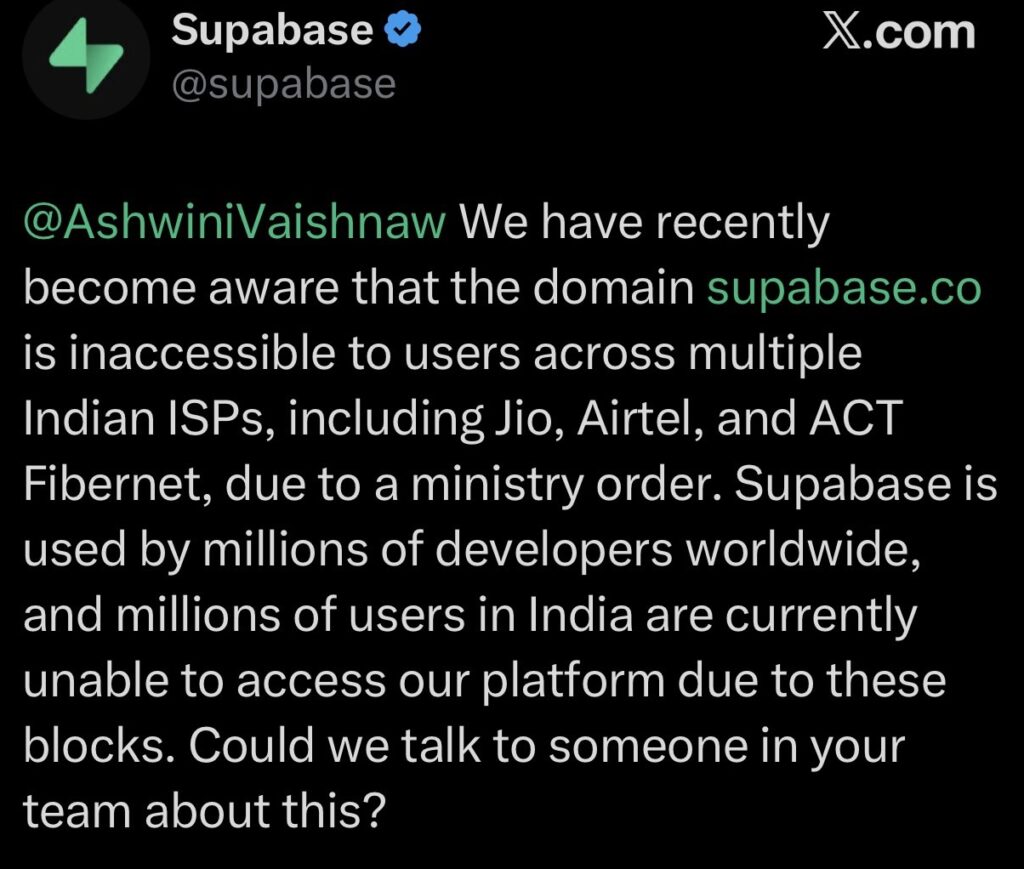
In their public communication, Supabase clarified that they are an open-source infrastructure provider -essentially the digital plumbing for software – not a platform hosting user-generated media. The company confirmed that their global backend remains fully operational and has requested an urgent dialogue with the Ministry to resolve the connectivity issues for their Indian user base.
Workarounds While Supabase is Blocked in India
Until MeitY lifts the ban or clarifies the order, developers must implement immediate triage strategies to keep their applications running.
- DNS Modification: The most common immediate fix for developers is switching their local or router DNS settings from the default ISP servers to public resolvers like Cloudflare (1.1.1.1) or Google (8.8.8.8).
- Virtual Private Networks (VPNs): Routing traffic through encrypted VPN tunnels can bypass the ISP block, though this introduces severe latency and is not a viable solution for end-consumers trying to use affected apps.
- Proxy Servers: Startups can rapidly deploy edge functions or reverse proxies hosted outside of India (e.g., via Cloudflare Workers or Vercel) to route their traffic to Supabase without directly hitting the blocked supabase.co domain.
- Migration: As a last resort, some startups are beginning the painful process of migrating their backend to competitors like Firebase, AWS Amplify, or Appwrite.
The fact that Supabase is blocked in India serves as a stark reminder of the fragile intersection between national digital policy and global tech infrastructure. As Indian startups scramble to implement reverse proxies and salvage their production environments, all eyes are on the Ministry of Electronics and IT to see if this disruption is a temporary bureaucratic error or a permanent shift in how India regulates foreign developer tools.
Tags: Supabase blocked in India, MeitY IT Act 69A, Jio Airtel outage, Supabase alternative, Ashwini Vaishnaw, developer ecosystem, backend infrastructure, startup crisis


Visit our website daily for latest tech news. Follow Us on Instagram for awesome tech stuff. Also, Join our Telegram Group and connect directly with Admin.